The Road Ahead: Agentic Omics in 2027 and Beyond

Introduction: Standing at the Inflection Point As we conclude the Agentic Omics series in March 2026, we find ourselves at a genuine inflection point. The past two years have witnessed extraordinary progress: AlphaFold 3’s extension to protein complexes and ligands, the emergence of 7B-parameter genome models like Evo, foundation models for single-cell biology achieving clinical utility, and the first wave of agentic systems orchestrating multi-step scientific workflows. Yet we also face sobering realities: Phase III clinical trial results remain the ultimate arbiter of success, regulatory frameworks are still crystallising, and the gap between computational prediction and biological causality remains stubbornly wide. ...
March 22, 2026 · 67 AI Lab
Multi-agent AI systems collaborating on biological research

Multi-Agent Systems for Biology: Collaborative AI Teams

Introduction No single AI agent can master all of biology. A genomics specialist doesn’t reason like a proteomics expert. A literature review agent has different skills from an experimental design agent. Yet biological discovery demands all of these perspectives working together. This is the promise of multi-agent systems for biology: collaborative AI teams where specialized agents debate, coordinate, and peer-review each other’s work — mimicking the collaborative nature of real scientific teams. ...

March 14, 2026 · 67 AI Lab
Agentic Omics architecture showing LLM orchestrating domain-specific biological AI models

The Agentic Omics Vision: LLMs Meet Domain-Specific AI

Introduction: The Convergence Point In Post 13, we defined agentic AI as systems that autonomously plan, reason, use tools, and execute multi-step scientific workflows. Now we arrive at the central thesis of this entire series: Agentic Omics — the convergence of large language model (LLM) reasoning with domain-specific biological AI models like AlphaFold, ESM, scGPT, and DNABERT to create autonomous systems capable of end-to-end biological discovery. This is not science fiction. As of early 2026, agentic systems are being deployed in operational drug discovery settings at companies like AstraZeneca, with documented implementations compressing workflows that once took months into hours while maintaining scientific traceability (Seal et al., 2025). The question is no longer if this convergence will transform biology, but how — and what architecture will get us there most reliably. ...

March 10, 2026 · 67 AI Lab
Single-cell multi-omics visualization with DNA, RNA, and protein layers

Single-Cell Multi-Omics: The Cellular Resolution Revolution

Introduction: The Cellular Resolution Frontier Biology has always been a story of scale. For decades, we studied organisms, then tissues, then cell populations — averaging signals across thousands or millions of cells. But tissues are not homogeneous. A tumor contains cancer cells, immune cells, fibroblasts, and endothelial cells, each with distinct molecular profiles. The brain contains hundreds of neuronal subtypes, each with unique functions. Even “identical” cells in culture exhibit stochastic variation in gene expression that can determine cell fate. ...

March 6, 2026 · 67 AI Lab
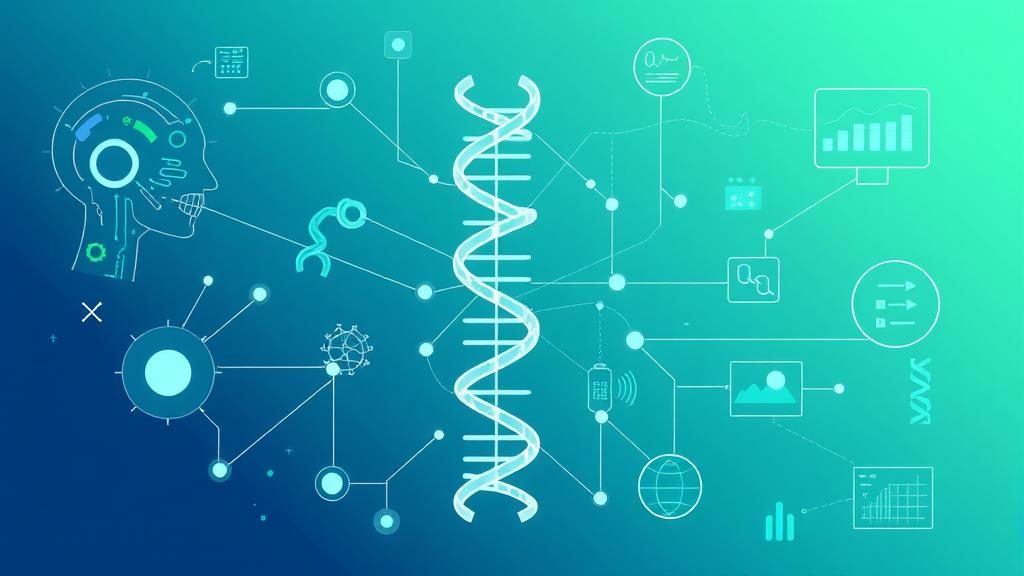
Multi-omics data integration visualization

Multi-Omics Integration: The Whole Is Greater Than the Sum

Multi-Omics Integration: The Whole Is Greater Than the Sum Biological systems are fundamentally multi-layered. The flow of information—from DNA (genomics) to RNA (transcriptomics) to proteins (proteomics) to metabolites (metabolomics)—does not exist in isolation. Yet, for decades, bioinformatics has largely treated these “omics” layers as separate silos. Today, artificial intelligence is breaking down these walls. In this post, we explore how AI-driven multi-omics integration is transforming precision medicine and systems biology, shifting the focus from individual modalities to the interconnected entirety of the cell. ...

March 6, 2026 · 67 AI Lab