Code Review Has to Change for AI-Generated Code
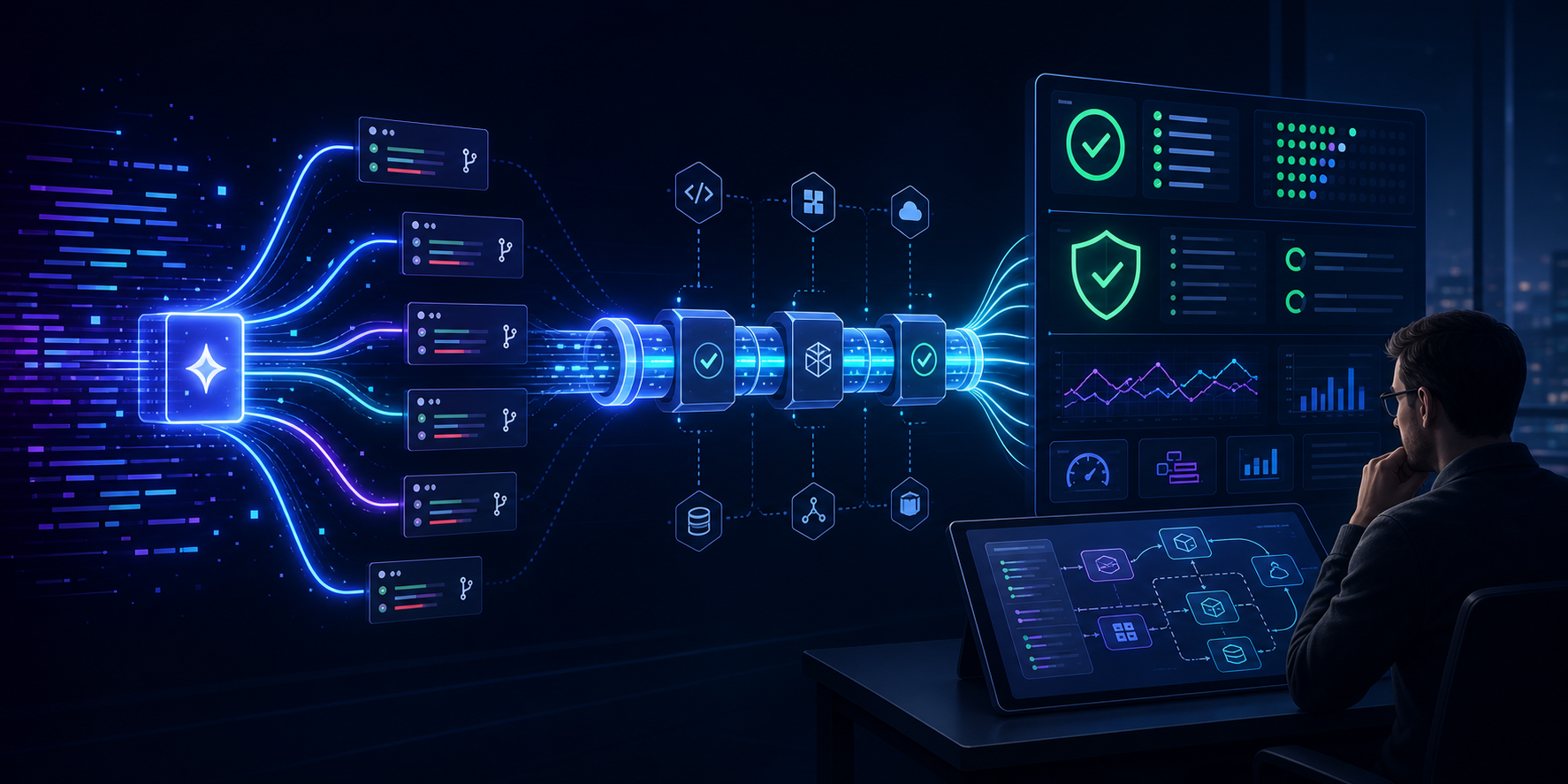
AI coding tools change the bottleneck in software engineering.
For years, the scarce resource was implementation time. A team could only produce as much code as its engineers could write, debug, and locally validate. AI coding assistants weaken that constraint. They can produce features, tests, migrations, refactors, and glue code much faster than a human team can type them.
That sounds like a productivity win, and often it is. But the downstream system still has to absorb the code. Somebody still has to understand the change, verify the behavior, check security boundaries, reason about failure modes, integrate it with the rest of the system, deploy it safely, and operate it after merge.
The bottleneck moves from writing code to verifying change.
That matters because the traditional review model was not designed for abundant code. Human line-by-line review does not scale when AI can generate large, polished-looking diffs on demand. The right response is not to make humans read faster. The right response is to change the review strategy.
The practical shift is this:
From human line-by-line code inspection to risk-based change verification.
The Short Version
AI-generated code should not get a free pass, but it also should not be reviewed as if every line deserves equal human attention.
A better workflow looks like this:
Specification
  -> AI generation
  -> deterministic verification
  -> AI-assisted review
  -> human residual-risk review
  -> post-merge validation
The human reviewer should move up the abstraction stack. Instead of asking, “Does every line look acceptable?”, the reviewer should ask:
- Did this implement the agreed intent?
- Does it preserve the system invariants?
- Are the tests strong enough for the risk?
- Are security, data, rollback, and observability concerns covered?
- Is the change small enough to understand and revert?
AI can help write code. Automation can check many mechanical properties. AI can even prepare useful review notes. But humans still own judgment, accountability, and residual system-level risk.
Why Line-by-Line Review Breaks Down
Line-by-line review has always had limits, but AI makes those limits harder to ignore.
First, AI can produce code faster than humans can inspect it. If every generated line requires the same amount of human attention as hand-written code, the review queue grows without bound.
Second, AI-generated code is often verbose. It may create extra abstractions, duplicate patterns, or produce broad changes that look organized but increase the review surface.
Third, the code is usually plausible. It may have clean names, consistent formatting, reasonable tests, and familiar idioms. That polish is dangerous because it can hide semantic errors: the wrong invariant, a missing edge case, a weak authorization boundary, a migration that cannot be retried, or observability that fails exactly when the system is under stress.
Fourth, diff size is not the same as risk. A ten-line authorization change can be more dangerous than a thousand-line generated fixture. A small retry loop can duplicate payments. A tiny schema change can break mixed-version deployment. Treating all lines as equal is the wrong unit of review.
Finally, human reviewers get tired. When every PR looks complete and confident, reviewers are tempted to skim. That is not a character flaw. It is a predictable result of putting scarce human attention against an expanding stream of plausible output.
The New Review Question
The old review question was:
Is this code acceptable line by line?
The better question is:
Is this change correct, safe, necessary, observable, maintainable, and aligned with system intent?
That is a different job.
It means reviewers should spend less time commenting on local implementation details that linters, type checkers, formatters, tests, and AI reviewers can catch. They should spend more time on intent and system behavior:
- What problem is this change supposed to solve?
- What behavior must change?
- What behavior must not change?
- Which contracts, APIs, schemas, permissions, or invariants are affected?
- What happens during retry, timeout, cancellation, rollback, or partial deployment?
- What would customer impact look like if this fails?
- Can the system detect and explain the failure?
This is where experienced engineers create the most value. Not by reading faster, but by knowing what matters.
Start With the Spec, Not the Diff
The biggest process improvement is to review intent before reviewing generated code.
In a diff-first workflow, the reviewer has to infer the goal from the implementation. That is slow even for human-written code. For AI-generated code, it is worse because the implementation may be large, confident, and directionally reasonable while still solving the wrong problem.
A spec-first workflow gives the reviewer an anchor.
The specification does not need to be a heavyweight design document. It can be an issue description, a short design note, an API contract, acceptance criteria, a migration plan, a state-machine invariant, or an executable test oracle.
The important part is that the implementation can be compared against agreed intent.
That changes the review from:
Is this code correct?
into:
Did the AI implement what we agreed to?
That is a safer and faster question.
A Practical Review Pipeline
A mature pipeline for AI-generated code has five layers.
1. Spec and Intent Check
Before generation or review, define the target:
- The problem being solved
- The expected behavior change
- The behavior that must remain unchanged
- The interfaces, schemas, or contracts affected
- The acceptance criteria
- The known failure cases
- The explicit non-goals
For high-risk changes, the specification should be approved before implementation. This prevents a large generated diff from becoming the first serious conversation about design.
2. Deterministic Automated Gates
Humans should not manually review what machines can reliably verify.
The baseline should include formatting, linting, type checking, unit tests, integration tests, contract tests, static analysis, secret scanning, dependency scanning, vulnerability scanning, API compatibility checks, migration validation, and performance regression checks where relevant.
For critical systems, add stronger tools: property-based tests, fuzzing, race detection, fault injection, rollback tests, mixed-version deployment tests, and formal or model-based checks where they make sense.
The principle is simple: deterministic checks should run before probabilistic review.
AI commentary can be useful, but tests, types, scanners, and executable specs provide a stronger foundation.
3. AI-Assisted Pre-Review
AI should prepare the review, not replace it.
Every AI-generated PR should include a structured explanation:
## What changed?
## Why?
## Specification or issue reference
## AI assumptions
## Files touched and rationale
## Public API / schema / config changes
## Risk areas
## Tests added
## Tests missing
## Rollback plan
## Observability impact
## Reviewer focus
The reviewer should not have to reverse-engineer the story from the diff.
AI can also perform a first-pass review: compare the implementation against the spec, flag missing tests, identify risky branches, look for security or concurrency problems, and point out rollback or observability gaps.
But this output is advisory. It is a filter, not a verdict.
4. Risk Classification
Review depth should follow risk, not diff size.
Low-risk changes include documentation, generated tests, formatting, internal scripts, and mechanical refactors with strong test coverage.
Medium-risk changes include business logic, API handlers, configuration changes, database queries, background jobs, and non-critical service behavior.
High-risk changes include authentication, authorization, billing, data migrations, distributed coordination, concurrency, infrastructure automation, production traffic routing, customer data access, and rollback-sensitive control planes.
High-risk AI-generated changes should be smaller, more heavily tested, and reviewed by humans with the right system context.
5. Human Residual-Risk Review
After the spec exists, automation has run, and AI has prepared the review, humans should focus on the remaining judgment calls:
- Is this the right problem to solve?
- Is the specification itself correct?
- Does the solution preserve architecture boundaries?
- Does it preserve system invariants?
- What happens under partial failure?
- Is rollback realistic?
- Does this increase operational complexity?
- Are alerts, logs, metrics, and dashboards enough to operate it?
- Is the blast radius acceptable?
That is the human role in an AI-heavy engineering workflow: not to out-type the machine, but to own the system.
Review by Invariants, Not by Lines
For AI-generated code, invariants are a better review unit than lines.
Examples:
- Authorization must happen before data access.
- Retries must not duplicate side effects.
- Requests must be idempotent where callers may retry.
- Timeouts must not leave inconsistent state.
- Public API behavior must remain backward compatible.
- Database migrations must be resumable and safe during mixed-version deployment.
- Metrics must expose success, failure reason, latency, and tenant impact.
- Configuration changes must be safe under partial rollout.
A line can look reasonable and still violate an invariant. An invariant-based review asks whether the system remains correct.
That is the level where human review scales better.
Keep PRs Small, Even If AI Generates Fast
AI makes it easy to create huge diffs. Huge diffs are bad review units.
A good PR should contain one logical change: one bug fix, one refactor, one API addition, one behavior change, or one test improvement.
Avoid combining feature work, refactoring, dependency upgrades, formatting changes, test rewrites, and migration logic in the same PR. AI tools often make this mixing feel cheap. Reviewers pay the cost later.
Small PRs reduce cognitive load, shorten feedback loops, improve review quality, and make rollback easier.
The rule is:
AI may generate fast, but PRs must remain small.
Treat AI-Generated Code Like Third-Party Code
A useful mental model is to treat AI-generated code like a third-party dependency.
The team may not have manually authored every line, but the team still owns what it ships. Authorship does not matter in production. Ownership does.
That implies clear interfaces, small blast radius, strong tests, security scanning, runtime monitoring, and the ability to replace or rewrite the generated code when it does not fit.
This framing also helps avoid a common trap: assuming code is safe because it was produced inside the team’s workflow. The origin is less important than the verification boundary around it.
What Leaders Should Measure
If AI coding changes the delivery system, teams need different metrics.
Useful signals include:
- PR volume
- Review latency by risk class
- Review queue depth
- AI-generated PR rejection rate
- Main-branch success rate
- Change failure rate
- Rollback rate
- Defect escape rate
- Mean time to recovery
- Senior-engineer review load
- Post-merge incidents linked to AI-generated changes
- AI review comments accepted versus ignored
The goal is not to maximize generated code. The goal is to maximize safely delivered value.
If PR volume goes up but main-branch health goes down, the organization has not improved throughput. It has moved work downstream.
The Practical Takeaway
AI-generated code requires a different review strategy.
The old model asks humans to inspect every line. That model cannot absorb AI-generated volume without creating review queues, fatigue, superficial approvals, and production risk.
The better model is spec-first, automation-heavy, AI-assisted, and human-accountable.
Humans should not try to match AI generation speed. They should move up the stack: intent, architecture, invariants, risk, operational correctness, and accountability.
The strategic shift is simple:
Stop reviewing code lines as the primary control. Start verifying system change.
Teams that make this shift can get the productivity benefits of AI coding without surrendering reliability, security, maintainability, or ownership. Teams that do not will generate more code, but not necessarily more safely delivered value.