
Is the AI Bubble About to Pop? Five Hard Truths from Ray Dalio
Most commentary on the AI boom argues about the technology. Ray Dalio’s argument is that the technology is beside the point.
In a July 2026 interview on The Diary Of A CEO, the Bridgewater founder made a case that has little to do with whether large models keep improving. His claim is about timing: the AI boom is a textbook investment bubble arriving at the intersection of a late-stage debt cycle, deep internal political fracture, and a shifting world order — the same three ingredients that, in his reading of five centuries of history, have preceded every major restructuring of an economic and political order.
You do not have to accept the whole framework to find the mechanics useful. What follows are five takeaways from that conversation, with the reasoning laid out so you can judge it. A note on sourcing before we start: this post summarises a single interview, and the figures below are Dalio’s own as stated on air, not independently audited. Treat it as one well-informed macro view, not as consensus.
1. The bubble test: wealth is not the same as money

Paper wealth can look abundant, but it becomes spendable only through a narrow market exit.
Dalio’s definition of a bubble is deliberately unglamorous. A bubble is not “prices are high” — it is that investors have stopped attending to the price they are paying relative to what they are buying, and are increasingly borrowing to do it. Revolutionary technology is the usual occasion for this, because a genuinely transformative story makes any price defensible.
“Wealth is not the same as money. You see a lot of people getting wealthy, but you can’t spend the wealth. You have to sell the wealth to get money because you can only spend money.”
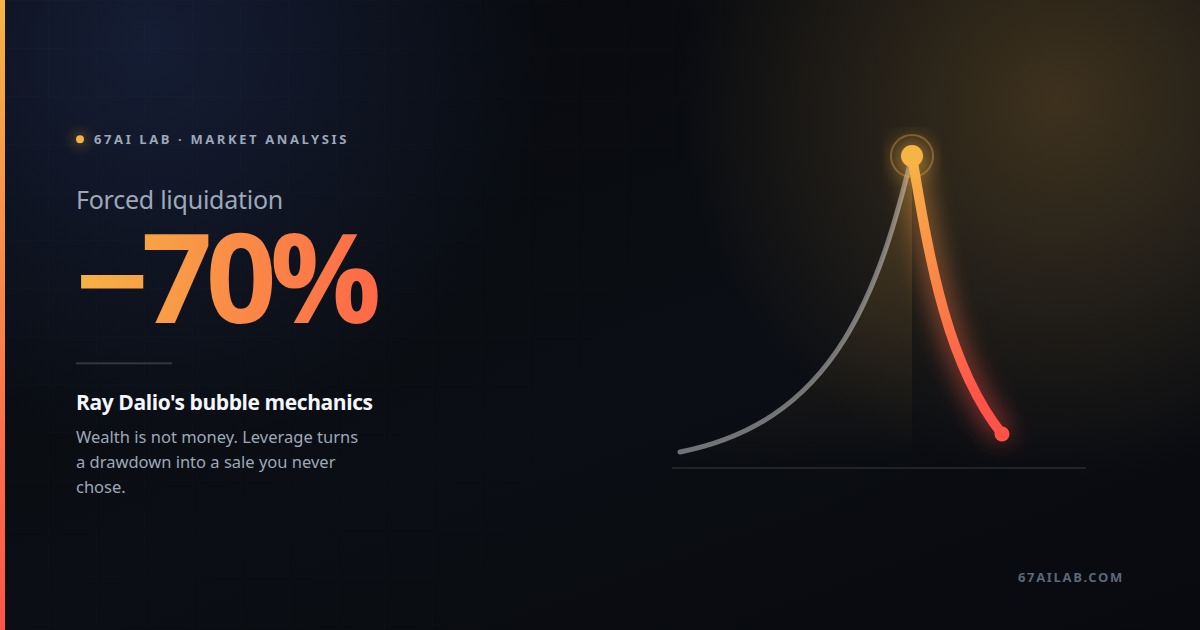
That distinction is the whole mechanism. Paper gains feel like security but are illiquid — they only become spendable when someone else buys at your price. The risk compounds when the position is held in what Dalio calls weak hands: non-specialist investors, leveraged, who bought because the price was going up. Margin positions and leveraged ETFs turn an ordinary drawdown into forced selling, because the collateral shrinks at exactly the moment the lender wants more of it. In a bear market, he argues, that feedback loop can take asset values down on the order of 70%.
Notably, his list of things that prick a bubble contains no technological failure at all:
- Rising interest rates, which raise the cost of carrying the debt behind the position.
- New taxes, which force holders to sell assets to raise cash.
- An oversupply of new equity issuance — “printing stock” — where the flow of new paper outruns the money available to absorb it.
The implication is worth sitting with: on this account, AI can deliver everything its advocates promise and the bubble can still burst, because what ends it is the financing, not the technology.
2. The 80-year Big Cycle
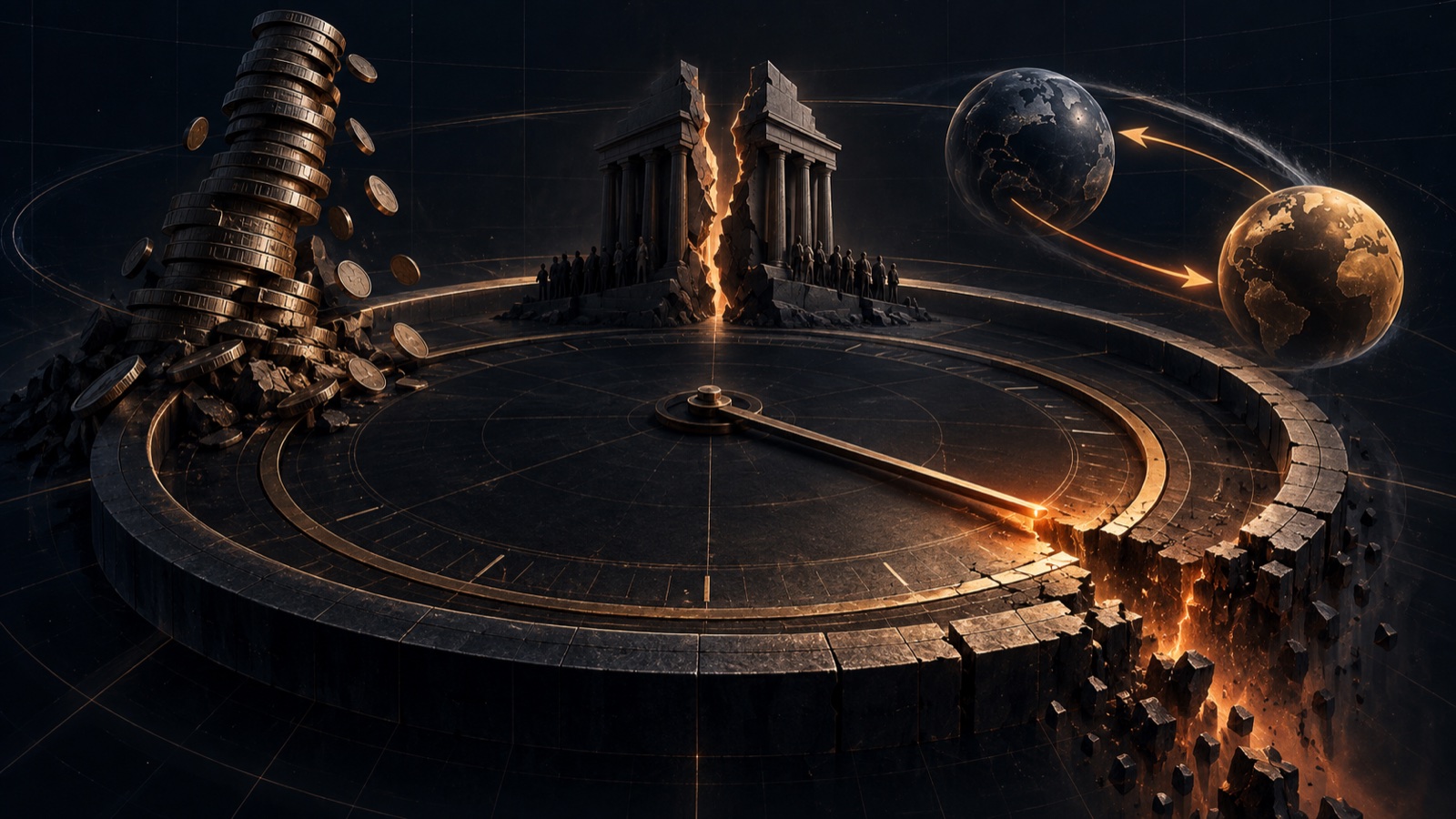
In Dalio’s framework, debt, internal fracture, and geopolitical transition converge late in the cycle.
The bubble matters because of when it is happening. Dalio places the present in the late stage of an 80-year cycle, itself nested inside a roughly 500-year pattern of the rise and decline of dominant powers. He reads the current phase as a rerun of the Gilded Age, pointing to a concentration of ownership in which the top 10% of US households hold close to 90% of stock value — which turns today’s fortunes into political targets and erodes the willingness to compromise.
Three forces drive the cycle in his telling:
- Debt. Governments borrow until debt service starts crowding out everything else they spend money on.
- Internal fracture. The gap between left and right widens until the system stops functioning for most of the people inside it.
- Geopolitical shift. A rising rival — China — contests both the existing order and the dollar’s reserve status.
His cautionary example is the United Kingdom: a country that, in his framing, has run out of money and run out of choices, and has cycled through six prime ministers in seven years as a symptom of that. When a government can no longer borrow freely, and can neither cut benefits nor raise taxes without losing the people it depends on, the existing order does not survive.
3. Cash is a “lousy” investment

Inflation erodes idle cash quietly; diversification spreads exposure across different sources of return.
The instinct in a bubble is to step aside into cash. Dalio thinks that instinct destroys wealth quietly rather than loudly.
The trap is inflation plus taxes. With inflation running around 3.5–4%, a nominal deposit yield is already close to a wash before tax — and after tax on the nominal interest, the real return turns negative. You feel safe while your purchasing power erodes on a schedule.
Underneath this is a claim about where returns actually come from: productivity, not currency. Your productivity equals your income, and the only durable way to hold value is to own assets that participate in human ingenuity rather than sitting outside it. His answer to the 70% drawdown risk is not cash but spread:
- Equities — a claim on the productivity of companies.
- Gold — hard money that is nobody else’s liability.
- Bonds — lending to governments, with inflation as the standing risk.
- Real estate — physical utility plus a forced savings mechanism.
“The best thing to do is to have a diversified portfolio… when you have that rather than any one, you won’t reduce your return but you will reduce your risk.”
The claim is the standard one about correlation, stated sharply: diversification is close to the only thing in finance that lowers risk without a matching cost in return.
4. The “Smart Rabbit” career

The smart rabbit keeps several paths open and uses AI to extend its options.
Dalio’s advice for individuals is the part most directly relevant to anyone building with these systems. If AI automates both the body — robotics — and the mind — higher-level reasoning — then a career staked on one employer, one skill, and one jurisdiction is a concentrated position in the exact asset class being repriced.
His metaphor is the smart rabbit with three holes: multiple income streams and multiple geographies, so that a path closed by regulation, redundancy, or a local downturn is never the only path. The same logic he applies to portfolios, applied to a life.
Two further moves follow. The first is partnership with AI rather than competition: as capital shifts toward those who own the tools and away from those who sell labour, the defensible human contribution moves toward judgement, emotion, intuition, and high-level conceptual framing — and toward using the tools to amplify all of that. The second is location. He argues for seeking out “Renaissance states” — places with capital, vibrancy, and enough civility to still function — rather than staying loyal to a decaying system out of habit.
“We are all on a journey to find the match between our nature and our path… your goal is to find that nature and what are the paths… they are constantly changing.”
The uncomfortable corollary is a widening gap: he expects the top decile of talent to command large premiums, and those who do not adapt to be displaced by automated agents.
5. Gold over Bitcoin

Dalio’s comparison: gold sits outside another party’s ledger; digital assets remain inside technical and political systems.
Dalio recommends holding 5–15% of a portfolio in hard money, and he is specific about which. His test is whether an asset is someone else’s liability. Gold passes: it is physical, it cannot be printed, and it remains the world’s second-largest reserve asset precisely because it sits outside anyone else’s balance sheet.
Bitcoin passes the printing test but fails others, on his reading:
- Quantum computing. A sufficient advance could threaten the cryptography underpinning a digital ledger. Gold has no equivalent failure mode.
- Privacy. Central banks and governments require confidentiality in their own transactions, which a public ledger does not provide — which limits Bitcoin’s path to becoming a reserve asset.
- Government control. If a monetary alternative ever genuinely threatened a state’s monetary monopoly, that state retains the power to tax it, regulate it, or ban it.
His geopolitical evidence is recent: when Russia’s financial assets were frozen and confiscated, its gold was the part that survived — because it was physical and held privately. The lesson he draws is that in a period of conflict, the settlement layer you depend on is a political risk, not just a technical one.
What to do with this
The through-line is that the system is being restructured because it has stopped working for most of the people in it, and that restructurings historically wipe out old debts and establish new orders with a great deal of turbulence in between. Dalio’s least fatalistic point is that this is manageable — but only through what he calls a strong middle: a bipartisan willingness to make difficult changes while keeping the bottom of society productive and civil.
For anyone building in AI, the useful reframe is that the two questions are separable. Will these systems keep getting better and more useful? and Are the assets priced on that premise being financed sustainably? are independent, and history suggests the second can resolve badly while the first resolves well. The 2000 crash did not mean the internet was a bad idea.
The interview closes on a question that is a better stress test than most portfolio models: if your current income stream vanished tomorrow, how many months — or years — could you actually survive?
Sources
- Primary source. Ray Dalio, interviewed by Steven Bartlett. “Ray Dalio: I Predicted The 2008 CRASH, I Know What Comes Next!” The Diary Of A CEO, published 30 July 2026: https://www.youtube.com/watch?v=Bu0xNDLNORU
All quotations and figures in this post are Ray Dalio’s as stated in that interview. They are his views and his numbers, reproduced here for discussion rather than independently verified, and nothing here is investment advice.