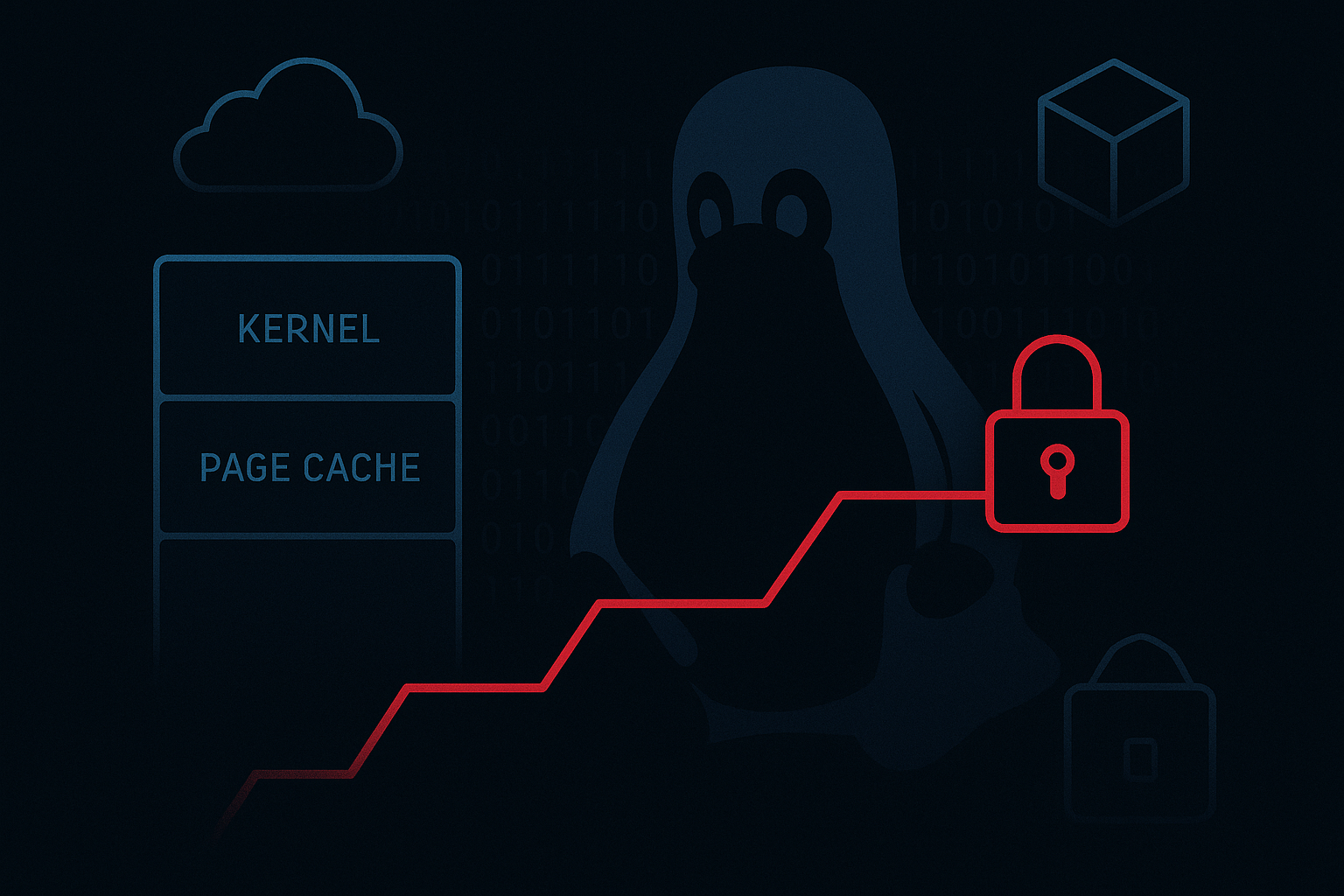
Linux kernel privilege escalation concept with memory pages, containers, and security signals

Copy Fail (CVE-2026-31431): Why a Small Linux Kernel Bug Became a Serious Root Escalation Risk

Date: May 2, 2026 Author: 67 AI Lab Classification: Public Technical Insight Executive Summary CVE-2026-31431, also known as Copy Fail, is a high-severity local privilege escalation flaw in the Linux kernel’s crypto subsystem. The bug lives in algif_aead, part of the AF_ALG userspace crypto interface, and traces back to an in-place optimization introduced in 2017. What makes this vulnerability unusually important is not just that it yields root, but that public analysis describes the exploit path as deterministic, compact, and cross-distribution. By chaining AF_ALG with splice(), an unprivileged local user can achieve a controlled 4-byte overwrite in page cache for a readable file. In practice, that is enough to corrupt the in-memory image of a setuid binary such as /usr/bin/su and obtain a root shell. ...

May 2, 2026 · 67 AI Lab
Split-screen visualization: A glowing blue local agent chip connected via fiber optics to a vast golden remote cloud brain.

Local vs. Remote Agents: Deployment Topologies for SRE

When we talk about “Agentic SRE,” we often focus on the what—what the agent can do, what models it uses, or what access it has. But in 2026, the critical architectural decision is actually the where. Does your SRE agent live inside your cluster, running as a Kubernetes operator with direct access to the control plane? Or does it live in a SaaS vendor’s cloud, ingesting telemetry and sending commands back over an API? ...

February 16, 2026 · 67 AI Lab