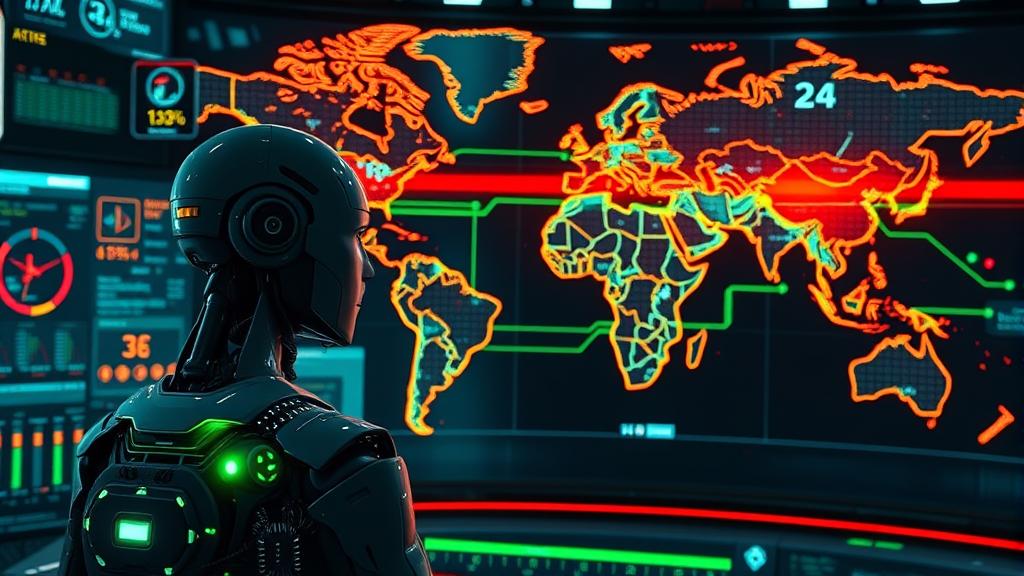
Futuristic digital illustration of biological data infrastructure

The Data Infrastructure Challenge: From Raw Reads to AI-Ready Datasets

The bottleneck for AI in computational biology is rarely a shortage of sophisticated models; it is the sheer difficulty of making biological data AI-ready. The “Agentic Omics” vision—where autonomous AI agents orchestrate domain-specific models to accelerate drug discovery—fundamentally rests on the assumption that these agents have access to standardized, clean, and computable data. In this post, we explore the unglamorous but critical foundation of omics AI: the data infrastructure. We trace the journey from raw sequencing reads to the structured tensor formats required by modern foundation models, exploring the evolving standards, the scale of the challenge, and how cloud infrastructure is adapting. ...

February 27, 2026 · 67 AI Lab
A transformer model reading DNA, RNA, proteins, and single-cell profiles as linked biological languages

Foundation Models Meet Biology: The Transformer Revolution in Life Sciences

In the first post of this series, we mapped the omics landscape: genomics, transcriptomics, proteomics, metabolomics, metagenomics, phenomics. The next question is obvious: why did AI suddenly get so good at several of these fields at once? The short answer is that biology turned out to be unusually compatible with the same family of models that transformed natural language processing. DNA, RNA, proteins, and even single-cell expression matrices are not “language” in any literal sense, but they are structured symbol systems with long-range dependencies, rich context, and vast quantities of unlabeled data. That is exactly the setting where self-supervised foundation models thrive. ...

February 25, 2026 · 67 AI Lab
Map of the omics layers interconnected by glowing data lines

The Omics Revolution: A Map of the Territory

Welcome to the first installment of Agentic Omics: When AI Reads the Book of Life. In this 24-part series, we will systematically review the state of the art of Artificial Intelligence (AI) across all major omics disciplines. We will explore how large language models, foundational transformer architectures, and eventually fully autonomous “Agentic Omics” systems are orchestrating domain-specific models to accelerate drug discovery, personalized medicine, and our fundamental understanding of biology. ...

February 25, 2026 · 67 AI Lab
A futuristic data center glowing with neon blue and purple lights, where holographic AI agents are actively collaborating and monitoring holographic system interfaces representing network reliability and self-healing infrastructure, cyberpunk digital art style

The Road Ahead: Agentic SRE in 2027 and Beyond

As we conclude our series on Agentic SRE, it’s time to pull back and look at the broader horizon. Over the past 11 posts, we’ve explored how autonomous agents are transforming incident response, change management, chaos engineering, and disaster recovery. But what happens when these point solutions fuse into a cohesive, system-wide paradigm? The transition from human-driven runbooks to AI-assisted operations was profound, but the shift from single-agent task execution to multi-agent, self-architecting systems will redefine the very nature of infrastructure. As we look toward 2027 and beyond, the technological landscape is shifting from fragmented AIOps tools to dynamic “agentic ecosystems” [1]. ...

February 24, 2026 · 67 AI Lab
A futuristic SRE control room where human engineers supervise holographic AI agents in a collaborative workspace.

The Human Factor: SRE Teams in the Age of Agents

If you ask an SRE in 2026 what their biggest fear is, it’s rarely “the site is down.” Agents like Sherlocks.ai or Azure’s SRE Agent handle that before the human even wakes up. The new fear is subtler: de-skilling. In the previous posts of this series, we’ve built a technological marvel: autonomous incident response, self-healing infrastructure, and AI-driven chaos engineering. But technology doesn’t exist in a vacuum. As we hand the pager to AI agents, the role of the human Site Reliability Engineer is undergoing its most radical shift since Google coined the term in 2003. ...

February 23, 2026 · 67 AI Lab
A futuristic diagram of an autonomous SRE agent architecture, showing a central brain connected to various monitoring tools and servers, glowing blue and green lines, high tech style

Architecting Autonomous, Long-Running, Scalable SRE Agents

It is relatively easy to build an SRE agent that can solve a single, well-defined problem in a demo environment. You give it a prompt, access to a few tools, and watch it restart a pod or query a log file. It feels like magic. But taking that agent and asking it to run 24/7, monitor thousands of services, handle concurrent incidents, and never hallucinate a destructive command is a different engineering challenge entirely. It moves us from the realm of “AI scripting” to distributed systems architecture. ...

February 22, 2026 · 67 AI Lab
A futuristic digital control room with a glowing holographic map of the world, showing data streams moving between continents under AI management.

AI-Driven Disaster Recovery: From Runbooks to Autonomous DR Drills

Disaster Recovery (DR) has traditionally been the “eat your vegetables” of IT operations: universally acknowledged as vital, but often neglected until a crisis forces the issue. In the pre-agentic era, DR testing was a high-stakes, high-effort event—a “Game Day” that required weeks of coordination, executive sign-off, and often a weekend of anxious monitoring. The result? Most organizations test their full DR plans annually at best. Between these rare tests, infrastructure drifts, configurations change, and the “tested” recovery plan slowly decays into fiction. ...

February 21, 2026 · 67 AI Lab
A futuristic digital illustration of an AI agent conducting a controlled chaos engineering experiment on a complex server infrastructure.

Autonomous Chaos Engineering: Agents That Break Things (Safely)

When Netflix introduced Chaos Monkey over a decade ago, the premise was radically simple: randomly terminate instances in production to force engineers to build resilient systems. It was blunt, effective, and terrified everyone who wasn’t Netflix. Over time, chaos engineering matured. We moved from random destruction to controlled experiments. Tools like Gremlin, Chaos Mesh, and LitmusChaos allowed SREs to precisely target blast radiuses—injecting latency into a specific microservice or dropping packets between two zones. But even with these tools, chaos engineering remained a high-friction activity. It required an SRE to hypothesize a failure mode, write the experiment code, schedule a “game day,” run it manually, and analyse the results. ...

February 20, 2026 · 67 AI Lab
Abstract 3D visualization of an AI security agent inspecting code streams

Agentic SRE: Safety and Security as First-Class Citizens

In traditional operations, security and reliability often find themselves at odds. The SRE team wants to ship features and maintain uptime; the security team wants to lock everything down, often slowing velocity. But in the world of Agentic SRE, this distinction is collapsing. Security is reliability. A breach is just a different kind of outage—one with potentially higher stakes. As we move into 2026, the mandate for SREs is expanding. It’s no longer enough to keep the site up; we must keep it safe. And just as we use agents to manage capacity and incidents, we must now deploy agents to manage safety and security. ...

February 19, 2026 · 67 AI Lab
Abstract 3D visualization of a software deployment pipeline, where a glowing blue AI agent is inspecting a code block before allowing it to merge into a massive complex network structure.

AI-Driven Change Management: Making Deployments Safer

This is Day 6 of our series “Agentic SRE: When AI Takes the Pager”. We’re exploring how AI agents are rewriting the rules of reliability, one domain at a time. “Don’t deploy on Friday.” It’s the oldest rule in the book. Why? Because historically, change is the single biggest predictor of instability. Google’s data suggests that roughly 70% of outages begin with a binary or configuration change [1]. For two decades, we’ve fought this with better testing, CI/CD pipelines, and rigorous code reviews. But the fundamental problem remained: we were pushing code faster than we could verify its safety. ...

February 18, 2026 · 67 AI Lab