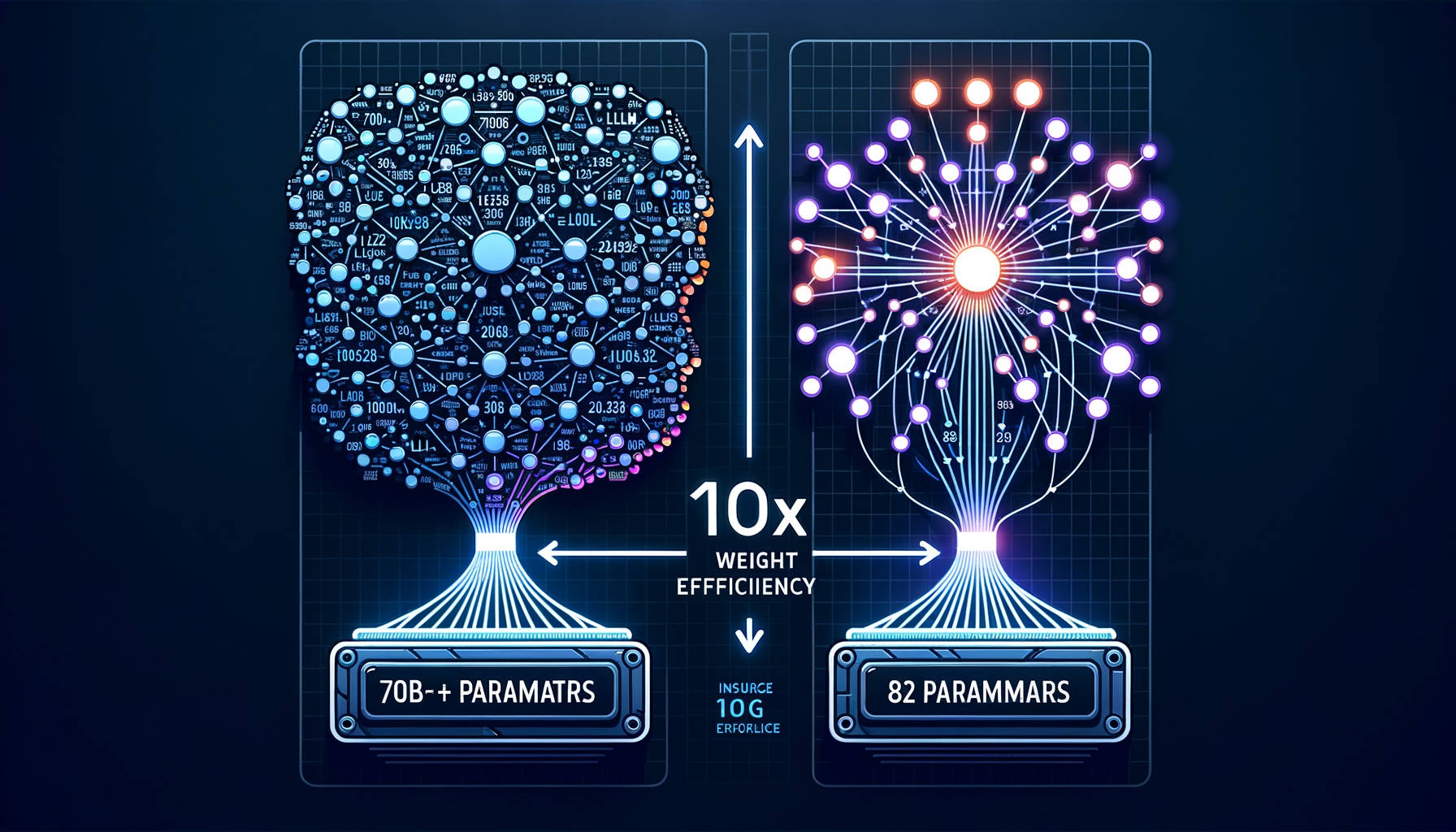
Visualization showing the evolution from large inefficient LLMs to smaller, more efficient models

The LLM Efficiency Revolution: How 8B Models Now Outperform 70B Giants

We are witnessing a massive paradigm shift in large language model development. A couple of years ago, the primary strategy to make an LLM smarter was simply to throw more parameters and raw compute at it. Today, models in the 7B to 8B parameter range easily outperform the 70B+ models of the past. This leap in “weight efficiency” isn’t happening by accident or mere trial and error. It is driven by highly deliberate, scientifically grounded methodologies across the entire training pipeline. ...

April 16, 2026 · 67 AI Lab
Scientific visualization of AI-powered theranostics and radiopharmaceutical dosimetry with neural network patterns

AI in Radiobiology & Radiopharmaceuticals: April 2026 Update

AI in Radiobiology & Radiopharmaceuticals: April 2026 Update Research Date: 2026-04-04 Category: AI-Radiobiology-Radiopharmaceutical Focus: AI-driven theranostics dosimetry, precision radiotherapy frameworks, and radiopharmaceutical discovery advances 1. AI-Enhanced Theranostics Dosimetry: Comprehensive 2025 Review A systematic review in Nuclear Medicine and Molecular Imaging (August 2025) examined deep learning applications in theranostic radiopharmaceutical dosimetry across three critical domains: image quality enhancement, dose estimation, and organ segmentation [1]. Deep Learning Architectures U-Net-based models: Primary architecture for organ segmentation, achieving Dice similarity coefficients >0.90 in benchmark challenges [1] Generative Adversarial Networks (GANs): Used for PET image synthesis and quality enhancement; Jyoti et al. achieved PSNR 32.83 and SSIM 77.48 for synthetic brain PET representing Alzheimer’s disease stages [1] Hybrid transformer networks: Emerging for multi-task dosimetry workflows combining segmentation and dose prediction [1] PET Image Synthesis Innovation Wang et al. demonstrated 3D U-Net synthesis of synaptic density (¹¹C-UCB-J) and amyloid deposition (¹¹C-PiB) PET from widely available ¹⁸F-FDG scans [1] Mean region-of-interest biases within ±2% across Alzheimer’s disease and cognitively normal groups [1] Applications: overcoming short-lived radionuclide imaging limitations, reducing radiation exposure, enabling delayed-time-point dosimetry without additional scans [1] Dosimetry Software Integrating AI QDOSE: Supports AI-based semi- and fully-automated organ segmentation, single time-point dosimetry, one-click hybrid dosimetry [1] MIM Software: Voxel-level dosimetry with AI-enhanced segmentation capabilities [1] VoxelDose, BigDose, RMDP: Additional voxel-based dosimetry packages incorporating ML components [1] Critical Challenges Identified Accurate dose estimation from theranostic pairs (diagnostic/therapeutic imaging correlation) [1] Lack of standardized imaging datasets for DL training [1] Radionuclide decay chain modeling complexity for multi-emitter isotopes [1] Need for optimization and standardization of AI models for clinical reliability [1] 2. Precision Radiotherapy Implementation Framework: Semantic AI Analysis A PMC-published study (2025) applied AI-driven semantic and temporal analysis to 3,343 unique articles (1964–2025) from Scopus, PubMed, and Web of Science, mapping radiotherapy-radiobiology-oncology evolution [2]. ...

April 5, 2026 · 67 AI Lab