
A Comprehensive Guideline for Extreme Risk Identification and Prevention for Hyper-scale Distributed Systems
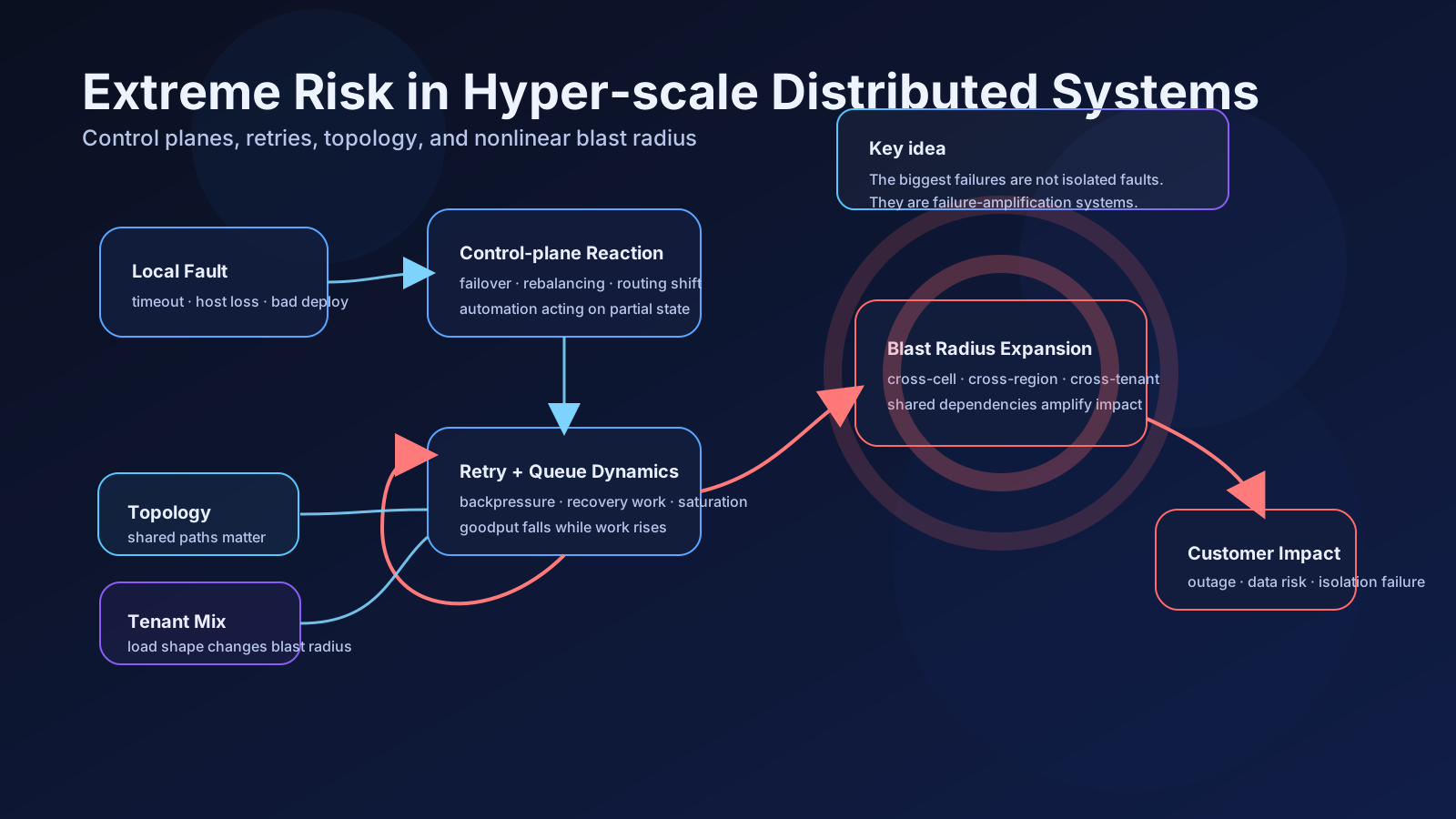
Hyper-scale distributed systems fail differently from ordinary software systems. Their most dangerous risks are rarely caused by one broken component. They emerge from the interaction of control planes, data planes, deployment automation, network topology, retry behavior, queueing dynamics, tenant workloads, and human operational decisions. In such systems, extreme risk means a low-frequency but high-consequence condition that can create nonlinear blast radius: regional degradation, global control-plane unavailability, cross-tenant impact, silent data corruption, large-scale isolation failure, or unrecoverable operational deadlock.
This guideline proposes a lifecycle-oriented framework for identifying and preventing extreme risk. The core argument is that no single methodology is sufficient. FMEA, fault trees, formal methods, STPA, probabilistic modelling, simulation, chaos engineering, observability, incident learning, and Generative AI-assisted analysis each see a different part of the risk surface. The practical goal is not methodological purity, but a closed-loop engineering system where risk models are created during design, verified before implementation, tested before release, validated in production, and continuously updated after incidents.
1. Introduction
Cloud-scale infrastructure has moved reliability engineering beyond the classical question of whether individual components fail. In global object storage, CDN, virtual networking, serverless compute, distributed databases, and elastic load balancing, failure is continuous. Machines fail, packets drop, disks degrade, control-plane operations race, operators make changes, tenants generate unpredictable workloads, and dependencies oscillate between healthy and degraded states.
The real challenge is not the existence of failure. The real challenge is whether local failure remains local. A single slow metadata partition may be harmless if traffic is isolated and clients back off. The same condition may become a regional incident if clients retry aggressively, load balancers shift traffic into already stressed cells, repair processes consume spare capacity, and telemetry is delayed. At hyper-scale, reliability engineering becomes the discipline of preventing local disturbance from becoming systemic failure.
This paper develops a comprehensive method for extreme risk identification and prevention. It is intentionally oriented toward complex cloud services rather than generic enterprise applications. Examples are drawn from object storage, CDN, VPC, elastic load balancing, distributed databases, block storage, Kubernetes-like orchestration, and hyperscale control planes.
The central claim is simple: at hyper-scale, the dominant risk is not component failure; it is uncontrolled failure amplification. The goal of risk engineering is therefore to identify, bound, dampen, and escape destructive system dynamics before they become customer-visible incidents.
2. Core Thesis: Why Extreme Risk Is Hard in Hyper-scale Distributed Systems
Extreme risk in hyper-scale distributed systems is hard because the most dangerous failures are not merely rare, large, or difficult to test. They are epistemically incomplete, dynamically nonlinear, interaction-driven, and sometimes metastable. They arise when locally reasonable mechanisms compose into globally destructive behavior, and they may persist even after the original trigger has disappeared.
In small systems, failure analysis often begins with a component-centric question: what can break? In hyper-scale systems, that question is necessary but insufficient. The more important question is: under what runtime conditions can correct components, correct automation, and correct operational procedures interact to create an unsafe system state?
This distinction is foundational. Extreme incidents are often not caused by one component violating its local contract. They are caused by multiple components faithfully executing their local contracts in a context where the composition becomes unsafe.
A retry mechanism improves availability under isolated transient failure. A load balancer improves utilization under normal demand. An autoscaler improves elasticity under gradual growth. A repair process improves durability after replica loss. A failover controller improves availability when one zone is impaired. Yet, under specific timing, load, topology, and feedback conditions, these same mechanisms can amplify work, spread failure, consume recovery capacity, or trap the system in a degraded state.
Therefore, extreme risk prevention is not only about preventing failures. It is about preventing failure amplification.

2.1 The Rumsfeld Matrix for Distributed-System Risk
The Rumsfeld uncertainty matrix is useful because it separates risk by knowledge state, not only by severity. Hyper-scale risk management fails when organizations treat all risks as if they were known knowns. The phrase “known knowns, known unknowns, and unknown unknowns” is associated with Donald Rumsfeld’s 2002 briefing and later became widely used as a risk and uncertainty framing device. A fourth category, often called “unknown knowns,” is particularly useful in complex system safety: risks that the organization in some sense already knows, but does not operationally acknowledge, encode, or act upon.

Known knowns are well-understood risks: node failure, disk failure, quorum loss, AZ loss, expired certificates, capacity exhaustion, schema incompatibility, or route misconfiguration. These can be addressed through FMEA, design reviews, runbooks, automated checks, and operational readiness reviews.
Known unknowns are risks the organization recognizes but cannot fully predict. Examples include the exact blast radius of a partial control-plane outage, the recovery time after a regional failover, or the safe repair concurrency under degraded capacity. These require simulation, probabilistic modeling, load testing, and controlled chaos experiments.
Unknown unknowns are risks the organization has not yet imagined. These are often interaction failures: retry policies interacting with autoscaling, health checks interacting with load shedding, deployment waves interacting with cache invalidation, or repair controllers interacting with customer traffic. These require STPA, adversarial review, chaos engineering, game days, incident mining, and diverse expert perspectives.
Unknown knowns are risks that exist somewhere in organizational memory but are not encoded into prevention mechanisms. They appear as repeated near misses, ignored operational pain, undocumented expert knowledge, temporary workarounds that became permanent, dashboards nobody trusts, and runbooks that only one engineer understands. These are socio-technical risks. They require COE discipline, operational governance, knowledge management, and accountable ownership.
This matrix leads to a practical conclusion: no single methodology can cover the full risk surface. Formal methods are strong for known invariants. FMEA is strong for known failure modes. STPA is strong for interaction and control risks. Chaos engineering explores known unknowns and sometimes reveals unknown unknowns. Incident learning converts unknowns into knowns. Generative AI can help mine unknown knowns, but it cannot replace engineering judgment.
2.2 Scale Converts Rare Events into Normal Events
The first theoretical difficulty is scale multiplication. At small scale, rare events may remain rare. At hyper-scale, the system continuously samples the tail of the probability distribution. If a condition has probability one in a million per operation, but the platform performs billions of operations per day, the condition is no longer exotic. It becomes expected background noise.
However, extreme risk is not only about event frequency. It is about coupling. A rare event becomes catastrophic when it touches a high-connectivity node, a shared control plane, a global dependency, a high-fanout workflow, or a mechanism that amplifies work.

This explains why classical component reliability is insufficient. A component with excellent individual reliability may still participate in a catastrophic system-level failure if it sits on a shared control path, coordinates recovery, or controls admission, routing, placement, identity, or metadata.
2.3 Combinatorial State Space Makes Exhaustive Reasoning Impossible
Hyper-scale distributed systems have enormous state spaces. The relevant state is not only application state. It includes configuration, topology, deployment version, traffic shape, retry state, queue depth, cache warmth, leader placement, repair backlog, quota consumption, health-check interpretation, tenant behavior, and operator intervention.
A simplified cloud object storage system may have millions of storage nodes, thousands of metadata partitions, multiple replication policies, background repair jobs, lifecycle management jobs, caches, placement controllers, request routers, and cross-region replication queues. Even if each component has a small number of possible states, the composed system has an astronomical number of possible global states.

This creates a fundamental limitation. Testing can sample states, but cannot exhaust them. Formal verification can prove properties, but only under a model abstraction. Simulation can explore scenarios, but only those encoded into the simulator. Chaos engineering can validate reality, but only within safe blast-radius boundaries. The extreme-risk program must therefore be explicit about coverage gaps. The question is not “have we tested everything?” but “which classes of state-space risk are covered by which method, and where are we blind?”
2.4 Destructive Emergent Behavior
Destructive emergent behavior is the central failure mechanism of large distributed systems. It occurs when individually valid local behaviors compose into globally harmful behavior.
A retry storm is the simplest example. A client retries because an RPC failed. A service mesh retries because the upstream appears unhealthy. A load balancer shifts traffic because one backend pool is slower. An autoscaler adds capacity because observed load has increased. Each action is locally rational. Together, they can multiply traffic, increase latency, consume queues, cause more timeouts, and reduce useful throughput.

The important lesson is that local correctness does not imply global safety. A system can satisfy every component-level contract and still fail catastrophically at the system level. This is why component-centric analysis such as FMEA must be complemented by interaction-centric analysis such as STPA, topology-aware simulation, and chaos engineering.
In hyper-scale systems, destructive emergence is amplified by ownership boundaries. One team owns the client SDK. Another owns the service mesh. Another owns load balancing. Another owns autoscaling. Another owns the backend service. Each team may optimize locally, while no single team fully owns the emergent feedback loop.
Therefore, extreme risk analysis must explicitly ask: what happens when all layers execute their fallback, retry, repair, rebalance, or failover logic at the same time? That question should become a standard design-review question for every critical cloud service.
2.5 Work Amplification as a Root Mechanism
Many severe distributed-system failures are work-amplification failures. A disturbance reduces capacity or increases latency. The system reacts by generating additional work. The additional work further reduces effective capacity, which triggers even more reaction.
A useful simplified model is:
effective_load = user_load + retry_load + recovery_work + control_plane_work

available_capacity = raw_capacity - failed_capacity - coordination_overhead - overload_penalty

risk rises sharply when effective_load > available_capacity
The dangerous part is that reliability mechanisms are often hidden load generators. Retries, failover, repair, rebalancing, cache refill, leader election, log replay, reconciliation, telemetry ingestion, and autoscaling all consume capacity. Under normal conditions, this overhead is small. Under stress, it can dominate the system.

The design implication is that resilience mechanisms must be explicitly budgeted. A retry policy without a retry budget is a distributed denial-of-service mechanism waiting for the right trigger. A repair process without admission control can compete with customer traffic. A failover mechanism without spare-capacity awareness can move load from one degraded area into another. A control-plane reconciliation loop without rate limits can turn inconsistency into overload.
A mature design review should therefore ask not only whether the system has retries, failover, and repair, but whether those mechanisms are bounded, prioritized, damped, and observable.
2.6 Metastable Failures
Metastable failure is one of the most important theories for understanding extreme risk in hyper-scale systems. A metastable failure occurs when a temporary trigger pushes the system from a healthy operating state into a degraded state, and the system remains degraded even after the original trigger is removed. The trigger starts the failure, but a sustaining mechanism keeps it alive.
The trigger may be a load spike, partial outage, network delay, dependency slowdown, deployment issue, cache invalidation, or leader failover. The sustaining mechanism may be retry amplification, queue buildup, cache stampede, repair backlog, connection churn, garbage-collection pressure, control-plane overload, or health-check instability.

Metastability explains why some incidents last much longer than the initiating event. The original trigger may last five minutes, but the incident may last hours because the system has entered a bad operating regime. Removing the trigger is not enough. The system needs an escape path.

The 2021 HotOS paper Metastable Failures in Distributed Systems describes metastable failures as a pattern in distributed systems that can appear as black-swan-like events with severe consequences. The later paper Formal Analysis of Metastable Failures in Software Systems provides mathematical foundations for metastability in request-response server systems. It models such systems with a domain-specific language, constructs continuous-time Markov chains, defines metastable behavior using escape probabilities, relates behavior to CTMC eigenvalue structure, and develops algorithmic tools to predict recovery times.
This distinction is critical for incident response. If engineers focus only on the trigger, they may declare the system “fixed” while the sustaining mechanism continues. For example, a transient traffic spike may end, but queues remain full. Queues cause timeouts. Timeouts cause retries. Retries keep queues full. The system is now failing because of its own recovery dynamics.
The prevention strategy is to design explicit escape mechanisms. These include admission control, load shedding, retry budgets, circuit breakers, queue draining, priority lanes for recovery traffic, brownout modes, backpressure propagation, client-side coordinated backoff, and controlled restart procedures.
A chaos experiment for metastability should not merely test whether the system survives the injected fault. It should test whether the system recovers after the fault is removed.

2.7 Why Hyper-scale Makes Metastability Worse
Hyper-scale intensifies all of the above mechanisms. First, scale turns rare events into routine events. A one-in-a-million event becomes expected when the system executes billions of operations. Second, scale increases the probability that multiple weak signals overlap: a deployment wave, a partial network impairment, a hot tenant, a cold cache, and a repair backlog may coincide. Third, scale creates shared mechanisms: global control planes, metadata services, identity systems, routing systems, deployment orchestrators, and observability pipelines. Shared mechanisms are high-leverage points where local problems can become systemic.
Most importantly, scale increases the strength of feedback loops. A small system may not generate enough retry traffic to keep itself overloaded. A hyper-scale system can. A small cache refill may be harmless. A global cache refill can overload storage. A small repair backlog drains quickly. A region-wide repair backlog can consume capacity for hours.

This is the paradox of hyper-scale resilience: the same mechanism that improves reliability in one operating region may destroy reliability in another. Therefore, the mature design question is not whether a mechanism improves resilience. The mature question is: under what conditions does this mechanism become an amplifier, and what bounds, damping, or escape mechanisms prevent that?
3. Risk Taxonomy and Knowledge Model
A useful risk taxonomy must classify risks by impact, mechanism, observability, and controllability. Severity alone is insufficient. Two risks may have the same severity but require completely different prevention strategies. A tenant-isolation violation requires formal access-control reasoning and deployment guardrails. A retry storm requires load testing, queueing analysis, client-library policy, and runtime observability. A regional control-plane overload requires topology analysis, failover simulation, and recovery playbooks.
The following risk classes are especially important for hyper-scale distributed systems.
| Risk Class | Typical Example | Primary Prevention Method |
|---|---|---|
| Data safety risk | Lost acknowledged write, silent corruption, snapshot lineage break | Formal specification, invariant testing, redundancy design |
| Tenant isolation risk | Cross-tenant access, unintended network reachability | Automated reasoning, policy analysis, least privilege |
| Control-plane systemic risk | Global scheduler, metadata, identity, quota, or placement outage | STPA, cell architecture, rate limits, graceful degradation |
| Work amplification risk | Retry storms, repair storms, cache stampedes | Queueing analysis, retry budgets, load shedding |
| Metastable failure risk | System remains degraded after trigger is removed | Escape mechanisms, chaos recovery experiments, damping |
| Deployment risk | Bad config or binary rolled out too quickly | Progressive delivery, blast-radius control, rollback |
| Observability risk | Blind spots, delayed signals, misleading health checks | Multi-layer telemetry, tenant-aware impact analysis |
| Socio-technical risk | Runbook gaps, tribal knowledge, ignored near misses | COE, operational readiness reviews, governance |
The taxonomy should become a shared engineering language. A service review should not merely say “high availability risk.” It should specify whether the risk is data safety, control-plane amplification, tenant isolation, metastability, or operational blind spot. Different risk classes require different tools.
4. End-to-End Risk Identification Lifecycle
Extreme risk identification should start before implementation and continue after production incidents. The lifecycle can be viewed as a pipeline, but in practice it must operate as a feedback loop.

The loop matters more than the individual boxes. A risk discovered in production should update the FMEA table, the STPA control model, formal invariants, chaos hypotheses, runbooks, dashboards, and operational readiness review questions. AWS describes Correction of Error as a process for improving quality by documenting and addressing issues, with standardized critical root-cause documentation and follow-through. AWS also describes Operational Readiness Reviews as a way to include business-specific, culture-specific, tool-specific, and governance-specific lessons in readiness reviews, with COE acting as a closed-loop post-incident mechanism.
The strongest organizations convert incident knowledge into reusable prevention mechanisms. A severe incident should not merely produce action items. It should produce new design constraints, new automated checks, new observability, new chaos experiments, and new readiness questions.
5. Classical Failure Analysis: FMEA, FTA, and HAZOP
Classical methods remain useful because they force engineering teams to name risks explicitly. FMEA asks how a component or function can fail, what the effect would be, how severe it is, how likely it is, and how detectable it is. Fault Tree Analysis starts from an undesirable top event and works backward through causal combinations. HAZOP examines deviations from intended behavior, such as more traffic than expected, less capacity than required, delayed replication, wrong routing decision, or stale metadata.
In hyper-scale systems, these methods are best used as risk enumeration tools, not as final truth. For example, in an object storage system, FMEA may identify failure modes such as metadata shard unavailability, quorum loss, replica placement bug, background repair backlog, stale bucket policy cache, or cross-region replication lag. These are useful starting points. However, the extreme risk usually appears when several individually tolerable failures combine: metadata leader failover coincides with traffic spike, repair workers consume capacity, clients retry aggressively, and the control plane delays placement updates.

The major advantage of FMEA is accessibility. It is easy to teach, easy to review, and easy to integrate into architecture review. Its weakness is that it often assumes linear causality. In complex distributed systems, causality is frequently circular. A slow dependency causes retries; retries cause overload; overload causes more slowness; health checks fail; traffic shifts; the shifted traffic overloads the next cell. Classical methods can document this chain, but they rarely discover it unless the participants already understand the pattern.
| Method | Best Use | Effectiveness | Adoption Cost | Major Trade-off |
|---|---|---|---|---|
| FMEA | Enumerating known component and service failure modes | Medium | Low | Good coverage of known risks, weak discovery of emergent risks |
| FTA | Explaining paths to a defined catastrophic event | Medium to High | Medium | Strong for causal reasoning, but can become too static |
| HAZOP | Discovering deviations from intended behavior | Medium | Medium | Good for structured reviews, but requires experienced facilitation |
For hyper-scale systems, FMEA should not stop at component failure. It should be extended with topology, tenant impact, control-plane dependency, retry behavior, and operational detectability. A useful FMEA row should answer not only “what fails?” but also “what amplifies this failure?” and “what prevents the blast radius from crossing a cell, AZ, region, tenant, or control-plane boundary?”
6. Formal Methods and Automated Reasoning
Formal methods address a different question from FMEA. FMEA asks what might go wrong. Formal verification asks whether we can prove that a property always holds under the model. This distinction is critical for extreme risk prevention because some failures are unacceptable even if their probability is low. Examples include losing acknowledged writes, violating tenant isolation, allowing unintended public access, double-allocating exclusive resources, or breaking a consensus safety invariant.
AWS is one of the strongest public examples of industrialized automated reasoning. AWS describes automated reasoning as the field that provides assurance about what a system or program will do or will never do, based on mathematical proof. AWS’s public material describes customer-facing automated reasoning capabilities such as S3 Block Public Access, IAM Access Analyzer, and VPC Reachability Analyzer.

For a cloud provider, the most valuable formal-method targets are not necessarily the largest systems. They are the smallest models with the highest safety value. A block storage system may not formally verify every line of implementation, but it can formally specify allocation invariants, volume attachment state transitions, snapshot lineage, replication quorum rules, and fencing behavior. A VPC system can formally check reachability, isolation, route-table semantics, and security-group interactions. An IAM system can formally analyze whether a policy grants unintended access.
The adoption cost is real. Formal methods require modelling skill, strong abstraction discipline, and integration into engineering workflows. They can also create false confidence if the model omits real-world failure modes such as delayed telemetry, operator mistakes, partial deployment, clock skew, or overload behavior. The correct stance is not “formally verified, therefore safe.” It is “this important invariant is verified under explicit assumptions.”
| Dimension | Strength | Cost / Limitation |
|---|---|---|
| Safety-critical invariants | Very high effectiveness; can eliminate entire classes of design bugs | Requires precise modelling and expert review |
| Configuration correctness | Highly practical; good fit for IAM, network, policy, access control | Needs formal semantics of configuration language |
| Distributed protocols | Powerful for consensus, replication, fencing, leader election | State explosion and abstraction difficulty |
| Runtime system behavior | Limited unless combined with monitoring and enforcement | Real systems include load, timing, and human factors not always modelled |
The best practice is to make formal verification part of a risk portfolio. It should protect the invariants that must never be violated, while chaos engineering and observability handle behavioral uncertainty that cannot be fully proven.
7. System-Theoretic Process Analysis: Discovering Control Failures
STPA is especially important for hyper-scale distributed systems because many catastrophic incidents are not caused by broken components. They are caused by unsafe control actions. A controller acts too early, too late, not at all, or with the wrong model of the system.
Google publicly states that it is using STPA to analyze pure software systems and discover unknown unknowns: risks teams are unaware of and not actively seeking. Google’s material frames STPA as focusing on how accidents and losses occur due to loss of control rather than component failures.
This makes STPA highly relevant for cloud control planes, autoscaling systems, traffic management, deployment automation, quota systems, load balancers, and repair controllers.

Consider a global CDN. A traffic manager observes elevated latency in one region and shifts traffic away. If the telemetry is delayed, the controller may shift traffic based on a stale view. If the destination region is already near saturation, the action can create a second failure domain. If clients retry during the shift, request volume increases exactly when the system has reduced stable capacity. No individual component is necessarily faulty. The accident emerges from a control action that is unsafe under specific context.
STPA would express this as follows: the traffic controller issues a rerouting action when the target region lacks safe spare capacity; it fails to issue a throttling action when retry traffic exceeds safe thresholds; it receives delayed feedback during a fast-moving load event; or it applies a global policy when the correct action should have been cell-local containment.
The benefit of STPA is that it discovers risks that FMEA misses. The cost is that it requires facilitation, system modelling, and participation from engineers who understand control logic, telemetry, operations, and failure history. It is not as mechanically scalable as static analysis. Google’s SRE material notes that scaling STPA required custom internal training, which is an important adoption signal: the method is powerful, but it requires organizational capability.
| Aspect | STPA Assessment |
|---|---|
| Effectiveness | High for emergent, interaction-driven, and control-plane risks |
| Adoption Cost | Medium to High, because it needs trained facilitators and cross-functional participation |
| Best Fit | Autoscaling, traffic engineering, deployment automation, repair systems, quota control, failover |
| Weakness | Less precise than formal methods; outputs need translation into concrete tests, monitors, and guardrails |
In practice, STPA should produce chaos hypotheses, design constraints, operational guardrails, and observability requirements. It should not remain a workshop artifact.
8. Probabilistic Risk and Tail-Risk Modelling
Formal methods reason about what is possible. Probabilistic methods reason about what is likely, how often, and under which load conditions. In hyper-scale systems, this matters because rare events happen frequently somewhere. A one-in-a-million condition becomes routine when multiplied by billions of requests, millions of disks, thousands of hosts, and continuous deployments.
The danger is that many teams model average behavior while incidents are driven by tail behavior. Tail latency, queue buildup, correlated failures, noisy-neighbor effects, and retry amplification are not well represented by simple mean-time-to-failure assumptions.

Queueing theory is particularly useful because many extreme incidents are queueing incidents in disguise. A backlog forms, work becomes stale, retries add more work, and the system spends capacity on requests that are unlikely to succeed. Amazon’s Builders’ Library discusses strategies for avoiding insurmountable queue backlogs, including bounding queues, rejecting excess work through rate limiting or load shedding, and using approaches such as LIFO in some contexts to process newer work that is more likely to succeed.
Retry storms are another example. AWS Well-Architected guidance warns that at scale, immediate retries can saturate networks with new and retried requests, reduce availability, and continue until full system failure.
The practical value of probabilistic analysis is not exact prediction. It is design pressure. It forces teams to ask whether a system degrades gradually or cliff-like, whether spare capacity is truly independent, whether retries are bounded, whether queues are finite, and whether failures are correlated.
| Method | What It Helps Quantify | Trade-off |
|---|---|---|
| Queueing theory | Saturation, backlog growth, tail latency | Sensitive to workload assumptions |
| Markov models | State transition probabilities and availability | Can oversimplify correlated failures |
| Monte Carlo simulation | Blast-radius distributions under random failure combinations | Requires good topology and failure distributions |
| Bayesian risk models | Updating likelihood based on incidents and near misses | Requires disciplined evidence collection |
| Extreme value theory | Rare tail events | Data-hungry and easy to misuse |
Probabilistic analysis is most useful when connected to production evidence. Model assumptions should be checked against real telemetry, incident reports, and chaos experiment results.
9. Simulation and Digital Twins
Simulation bridges the gap between abstract analysis and production experimentation. A simulator can explore more scenarios than chaos engineering can safely execute in production, while still capturing topology, workload shape, failover policy, and capacity constraints more concretely than a static design review.
For cloud services, simulation should not attempt to model everything. It should focus on decision-sensitive dynamics. For an object storage service, useful simulations include replica placement under correlated rack failures, repair backlog under degraded capacity, metadata shard failover under traffic skew, or cross-region replication under network impairment. For a CDN, useful simulations include cache-miss amplification, origin shielding behavior, request routing under regional degradation, and control-plane propagation delay. For virtual networking, simulations can explore route convergence, security policy propagation, encapsulation failure, or flow-table exhaustion.

The biggest limitation is model fidelity. A simulator that omits retry behavior may underestimate overload. A simulator that assumes independent failures may underestimate correlated risk. A simulator that ignores operational state may miss deployment-induced failure. Therefore, simulation should be continuously calibrated using production telemetry and incident data. The goal is not a perfect digital twin; it is a useful decision-support model that makes risk assumptions explicit.
10. Chaos Engineering and Empirical Validation
Chaos engineering tests whether the system behaves as expected under turbulent conditions. The Principles of Chaos Engineering define the practice around steady-state behavior, hypothesis formation, realistic fault injection, and attempts to disprove the hypothesis by observing whether steady state changes.
For hyper-scale systems, chaos engineering should not be random destruction. It should be hypothesis-driven, topology-aware, and risk-informed. A good chaos experiment starts from a risk model: FMEA identifies the failure mode, STPA identifies unsafe control actions, probabilistic modelling identifies high-risk contexts, and observability defines measurable steady state.

A weak chaos experiment says, “kill random instances.” A strong chaos experiment says, “during 70% regional traffic load, inject 300 ms latency into metadata quorum reads for one storage cell, verify that client-visible p99 latency remains below the SLO, repair backlog does not exceed threshold, request retries remain bounded, and no tenant outside the cell is impacted.”
Netflix’s Chaos Monkey is historically important because it randomly terminates production instances to ensure services are resilient to instance failure. But hyperscale cloud providers need to go beyond instance termination. They need cell-aware, tenant-aware, topology-aware, control-plane-aware, and dependency-aware experiments.
Chaos engineering is highly effective at revealing reality gaps. Its adoption cost is also high because unsafe chaos can become the outage it was meant to prevent. The hard part is not injecting faults. The hard part is selecting meaningful experiments, defining safe blast radius, building abort mechanisms, and ensuring teams act on the findings.
| Dimension | Chaos Engineering Assessment |
|---|---|
| Effectiveness | Very high for validating real resilience and exposing hidden coupling |
| Adoption Cost | High in production; medium in staging |
| Best Fit | Failover, dependency failure, network impairment, quota exhaustion, overload, partial regional degradation |
| Major Risk | Poorly designed experiments can cause customer impact |
| Required Guardrails | SLO aborts, blast-radius limits, automatic rollback, experiment approval, tenant protection |
The key is to treat chaos engineering as controlled scientific experimentation, not as resilience theatre.
11. Observability and Runtime Risk Detection
Observability is not only for debugging incidents. In extreme risk management, observability is the runtime sensor network for the entire risk system. Without it, FMEA cannot validate detectability, STPA cannot validate feedback paths, probabilistic models cannot be calibrated, and chaos experiments cannot determine whether the hypothesis held.
For hyper-scale systems, observability must be multi-layer and tenant-aware. It should connect physical infrastructure, network flows, virtual resources, service dependencies, control-plane state, and customer impact.

The most important signals are often not generic CPU or memory metrics. They are early-warning indicators of nonlinear transition: retry rate, queue age, backlog growth rate, failover frequency, control-loop oscillation, partial deployment skew, replica repair debt, admission-control rejection rate, and per-tenant error-budget burn.
The trade-off is cost and complexity. High-cardinality telemetry is expensive. Full tracing at hyperscale can be impractical. The design challenge is to collect enough structure to diagnose blast radius without drowning teams in noise.
12. Incident Learning and COE as Risk-Model Update Mechanism
Many organizations perform postmortems. Fewer systematically convert incident knowledge into preventive mechanisms. AWS’s COE material is valuable because it frames incident analysis as a mechanism for improving quality through documented root causes and corrective actions, not merely as a narrative record.
In hyper-scale systems, every severe incident should update the risk model. If an incident involved retry amplification, retry policy should be added to FMEA and chaos experiments. If it involved stale telemetry, STPA feedback paths should be updated. If it involved an invariant violation, formal specifications should be added or strengthened. If it involved late detection, observability and SLO alerting should be redesigned.

The adoption trade-off is organizational. COE requires discipline, ownership, and executive support. Without that, corrective actions become tickets that age out. With it, incidents become compounding organizational knowledge.
13. Generative AI and Agentic Risk Analysis
Generative AI has strong potential in extreme risk identification, but it must be used carefully. Its value is not that it can understand a complex system better than senior engineers. Its value is that it can operate as a tireless risk-analysis assistant over large, messy bodies of information: design docs, incident reports, runbooks, topology graphs, configuration repositories, code diffs, dashboards, and operational tickets.
A realistic GenAI-assisted risk platform would look like this:

The most promising use cases are risk-surface expansion, not autonomous decision-making. A GenAI system can suggest overlooked failure modes, compare a new design against past incidents, identify missing telemetry, translate STPA hazards into chaos hypotheses, draft FMEA tables, summarize configuration drift, or propose invariants for formal verification. It can also help detect inconsistency between documentation and implementation.
Agentic chaos engineering is a natural next step, but it needs strong safety boundaries. An AI agent may propose experiments, simulate expected behavior, validate policy constraints, and generate observability checks. It should not directly execute high-blast-radius experiments in production without policy gates, blast-radius limits, approval workflow, automatic abort conditions, and auditability.

For AI agents themselves, chaos engineering becomes even more important. Agentic systems introduce new failure modes: tool misuse, hallucinated operational plans, runaway loops, incorrect memory, prompt injection, multi-agent cascading errors, and unsafe autonomy. A production-grade AI operations agent should therefore be treated as a distributed system with its own control loops, dependencies, identity boundaries, memory stores, model drift, and failure modes.
| AI Capability | Potential Value | Risk / Trade-off |
|---|---|---|
| FMEA generation from design docs | Speeds up first-pass risk enumeration | May hallucinate irrelevant risks or miss deep domain issues |
| STPA assistance | Helps identify unsafe control actions and missing feedback | Requires expert validation of control structure |
| Formal invariant suggestion | Accelerates discovery of properties worth proving | Suggested invariants may be incomplete or unprovable |
| Chaos hypothesis generation | Converts risk models into testable experiments | Unsafe if experiments are not constrained |
| Incident mining | Extracts recurring patterns across COEs | Sensitive to data quality and taxonomy consistency |
| Agentic remediation | Could close loop from detection to mitigation | High risk without strict permissions, rollback, and human oversight |
The near-term opportunity is human-supervised AI for risk analysis. The longer-term opportunity is policy-constrained autonomous resilience engineering, where agents continuously inspect topology, propose experiments, verify guardrails, and learn from outcomes. But that future requires formal safety policies, strong identity boundaries, auditable decisions, and explicit human accountability.
14. Comparative Methodology Map
The following table summarizes where each method fits. The important point is that these methods are complementary, not competing.
| Method | Primary Question | Best Lifecycle Phase | Effectiveness Against Extreme Risk | Adoption Cost | Main Limitation |
|---|---|---|---|---|---|
| FMEA | What can fail? | Design | Medium | Low | Weak on emergent behavior |
| FTA | How can this top event happen? | Design / incident analysis | Medium | Medium | Depends on known causal paths |
| Formal methods | Can this invariant ever be violated? | Design / build / config validation | Very high for bounded properties | High | Requires precise abstraction |
| Automated reasoning | Is this config or policy safe? | Build / deploy / runtime guardrail | High | Medium to High | Needs formal semantics |
| STPA | How can control become unsafe? | Design / pre-production / incident learning | High | Medium to High | Needs trained facilitation |
| Probabilistic modelling | How likely is this risk? | Design / capacity / production | Medium to High | Medium | Assumption-sensitive |
| Simulation | What happens under many scenarios? | Pre-production | High if topology is accurate | Medium to High | Model fidelity problem |
| Chaos engineering | What actually happens? | Staging / production | Very high | High | Coverage and safety constraints |
| Observability | Is risk materializing now? | Production | High | High | Cost and signal-noise trade-off |
| COE / incident learning | How do we prevent recurrence? | Post-incident | High | Medium | Requires organizational discipline |
| GenAI-assisted analysis | What risks might we have missed? | All phases | Medium today, potentially high | Medium | Requires verification and governance |
A mature risk program should be able to explain which method covers which part of the risk surface and where residual uncertainty remains. This is not merely a process exercise. It is the basis for responsible risk acceptance.
15. Practical Adoption Strategy
A cloud provider should not attempt to adopt every method at once. The pragmatic sequence is to build a minimum closed loop first, then deepen each part.
The first step is to standardize risk language. Define what counts as extreme risk: tenant-wide impact, cell-wide impact, regional impact, global control-plane risk, data durability risk, security isolation risk, operational irrecoverability, and correlated multi-service failure. Without this taxonomy, different teams will optimize for different definitions of severity.
The second step is to require every major architecture review to produce three artifacts: a high-quality FMEA table, a control-structure diagram for STPA-style reasoning, and a set of invariants that may be candidates for formal verification or automated checks.
The third step is to connect these artifacts to pre-production validation. Every high-severity failure mode should map to either a formal proof, a simulation, a load test, a chaos experiment, a deployment guardrail, or a conscious risk acceptance.
The fourth step is to build a production risk graph. This graph should connect services, cells, regions, tenants, control planes, data planes, dependencies, quotas, deployment waves, and operational ownership. Without a risk graph, blast radius remains a manual guess.
The fifth step is to introduce AI carefully. Start with AI-assisted risk drafting and incident mining. Do not begin with autonomous chaos execution. Let AI propose risks, hypotheses, and observability gaps, but require human review and policy-based validation.

The best adoption signal is not the number of documents produced. It is whether severe risks discovered in design, testing, production, and incidents are consistently converted into reusable controls.
16. Conclusion
Extreme risk prevention in hyper-scale distributed systems requires a shift from isolated reliability practices to an integrated risk engineering system. FMEA gives structure to known failure modes. Formal methods provide hard guarantees for critical invariants. STPA exposes unsafe control actions and missing feedback. Probabilistic models quantify residual uncertainty. Simulation explores scenario space. Chaos engineering validates actual runtime behavior. Observability detects risk materialization. COE converts incidents into institutional learning. Generative AI can amplify all of these methods, but only when constrained by human expertise, formal policy, and strong operational guardrails.
The central principle is simple: model the system before it fails, prove what must never break, quantify what remains uncertain, test what reality actually does, observe continuously, and feed every lesson back into the design.
At hyper-scale, the dominant risk is not component failure. It is uncontrolled failure amplification. The goal of risk engineering is therefore to identify, bound, dampen, and escape destructive system dynamics before they become customer-visible incidents.
References
- [1] AWS, “What is Automated Reasoning?” https://aws.amazon.com/what-is/automated-reasoning/
- [2] AWS, “Provable Security – Automated Reasoning.” https://aws.amazon.com/security/provable-security/
- [3] Amazon Science, “A gentle introduction to automated reasoning.” https://www.amazon.science/blog/a-gentle-introduction-to-automated-reasoning
- [4] Amazon Science, “Custom policy checks help democratize automated reasoning.” https://www.amazon.science/blog/custom-policy-checks-help-democratize-automated-reasoning
- [5] AWS, “Correction of Error (COE).” https://wa.aws.amazon.com/wellarchitected/2020-07-02T19-33-23/wat.concept.coe.en.html
- [6] AWS, “Operational Readiness Reviews.” https://docs.aws.amazon.com/wellarchitected/latest/operational-readiness-reviews/wa-operational-readiness-reviews.html
- [7] AWS Public Sector Blog, “Announcing the AWS Well-Architected Operational Readiness Review Lens.” https://aws.amazon.com/blogs/publicsector/announcing-aws-well-architected-operational-readiness-review-lens/
- [8] Google SRE, “STPA (System Theoretic Process Analysis) at Google.” https://sre.google/resources/practices-and-processes/stpa/
- [9] Google SRE, “STPA: Teaching a new risk analysis method.” https://sre.google/stpa/teaching/
- [10] Nathan Bronson, Abutalib Aghayev, Aleksey Charapko, and Timothy Zhu, “Metastable Failures in Distributed Systems,” HotOS 2021. https://sigops.org/s/conferences/hotos/2021/papers/hotos21-s11-bronson.pdf
- [11] Rebecca Isaacs, Peter Alvaro, Rupak Majumdar, Kiran-Kumar Muniswamy-Reddy, Mahmoud Salamati, and Sadegh Soudjani, “Formal Analysis of Metastable Failures in Software Systems,” arXiv:2510.03551, 2025. https://arxiv.org/abs/2510.03551
- [12] AWS Builders’ Library, “Avoiding insurmountable queue backlogs.” https://aws.amazon.com/builders-library/avoiding-insurmountable-queue-backlogs/
- [13] AWS Builders’ Library, “Instrumenting distributed systems for operational visibility.” https://aws.amazon.com/builders-library/instrumenting-distributed-systems-for-operational-visibility/
- [14] Principles of Chaos Engineering. https://principlesofchaos.org/
- [15] Netflix, “Chaos Monkey.” https://netflix.github.io/chaosmonkey/
- [16] AWS Machine Learning Blog, “Streamlining the Correction of Errors process using Amazon Bedrock.” https://aws.amazon.com/blogs/mt/streamlining-the-correction-of-errors-process-using-amazon-bedrock/