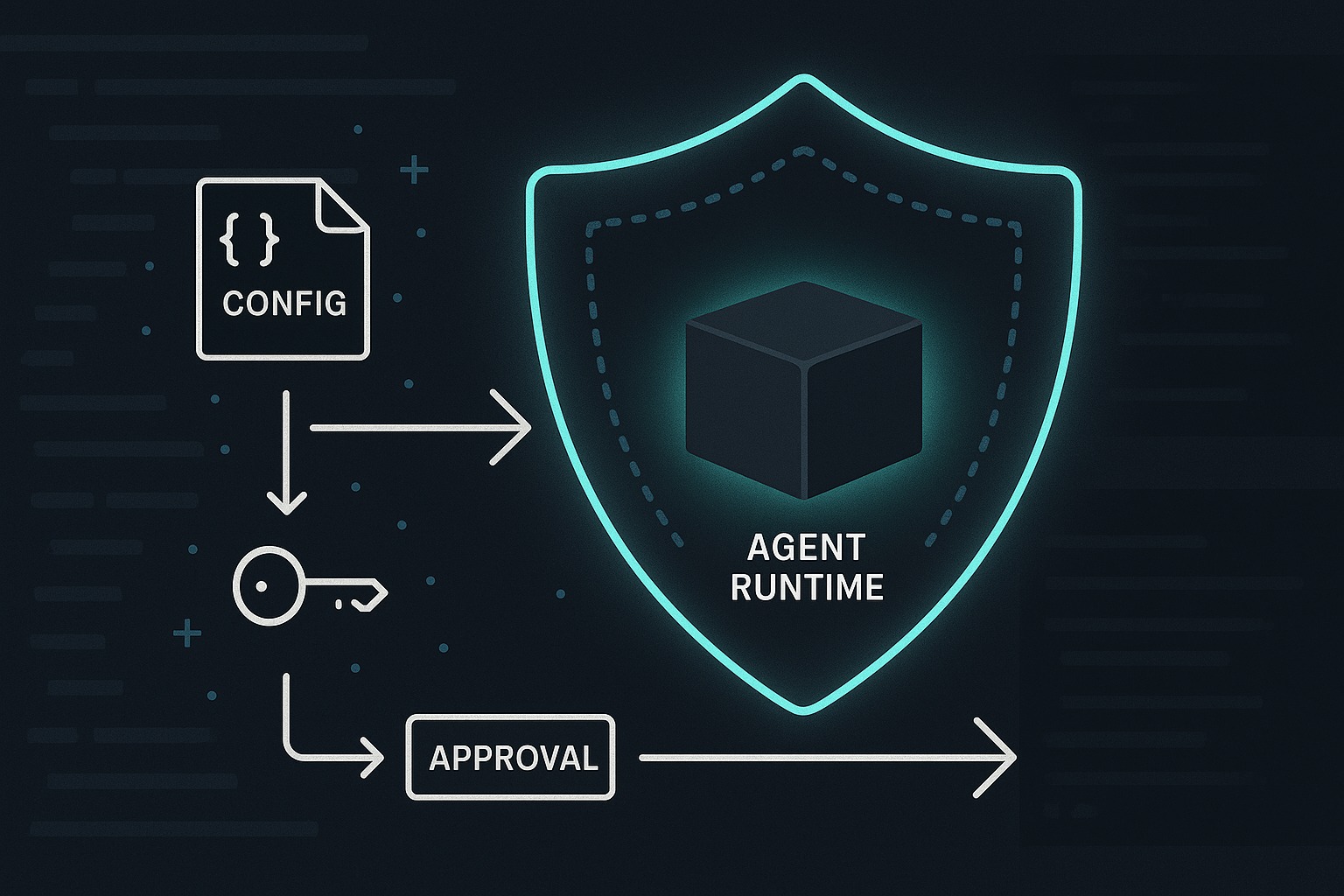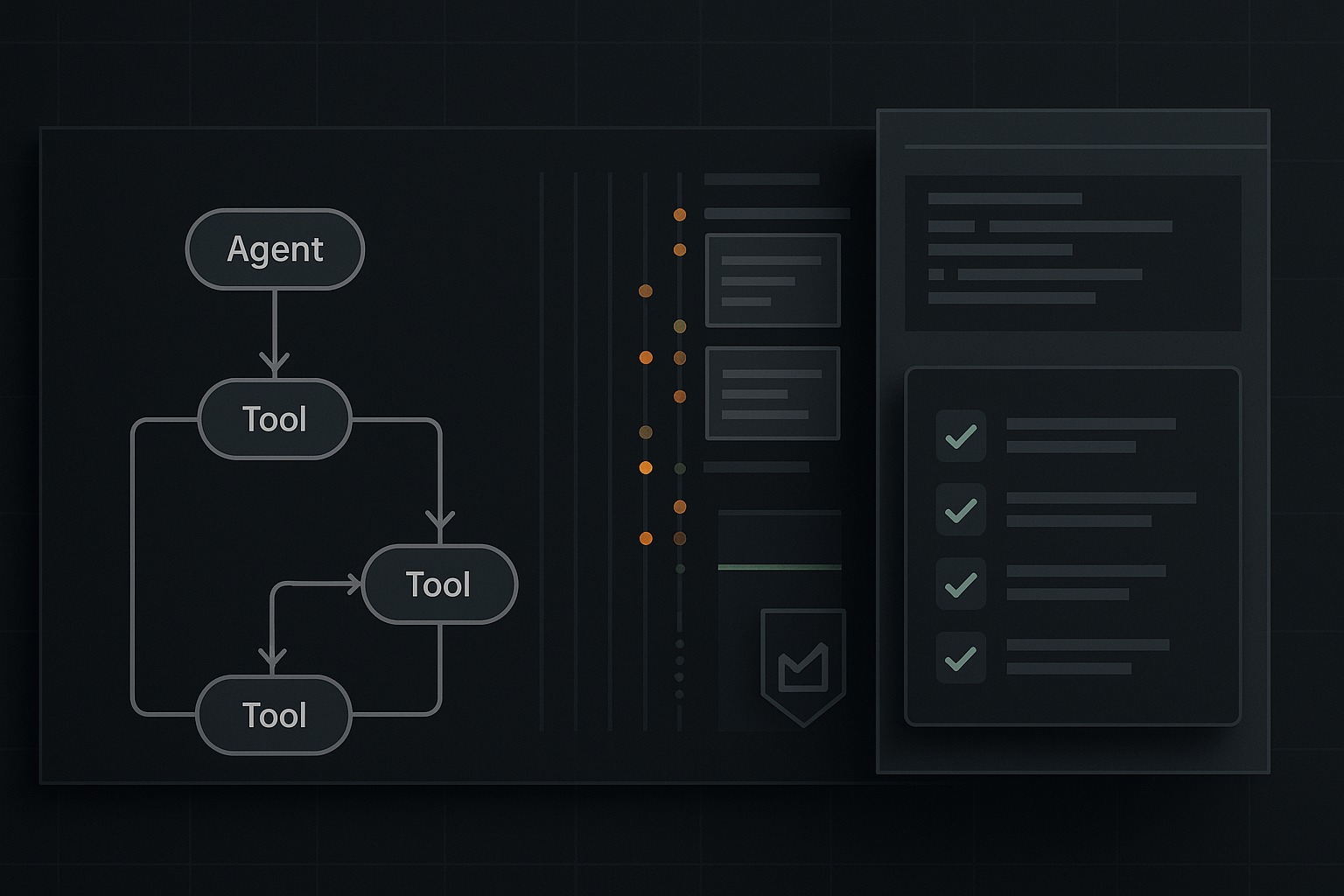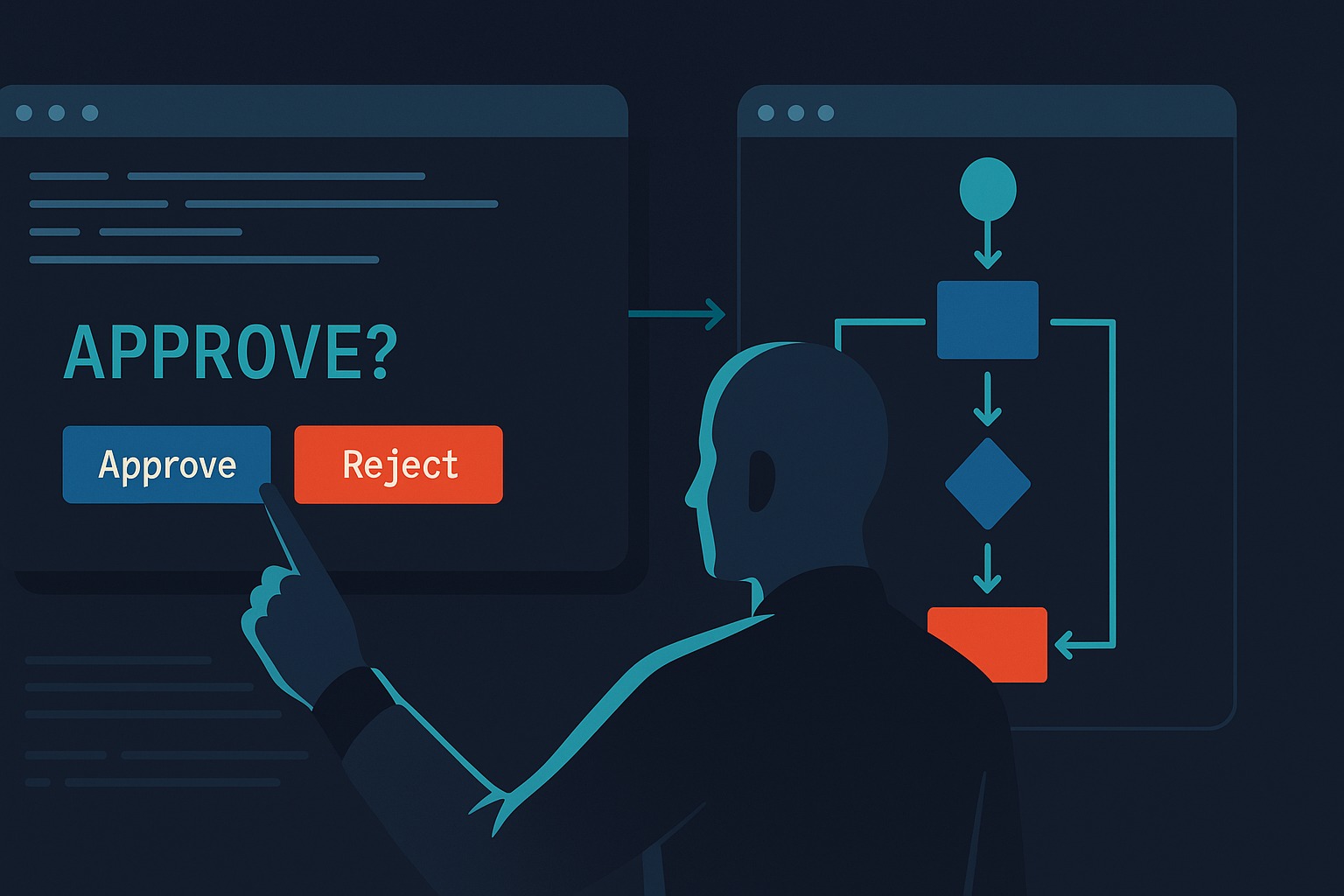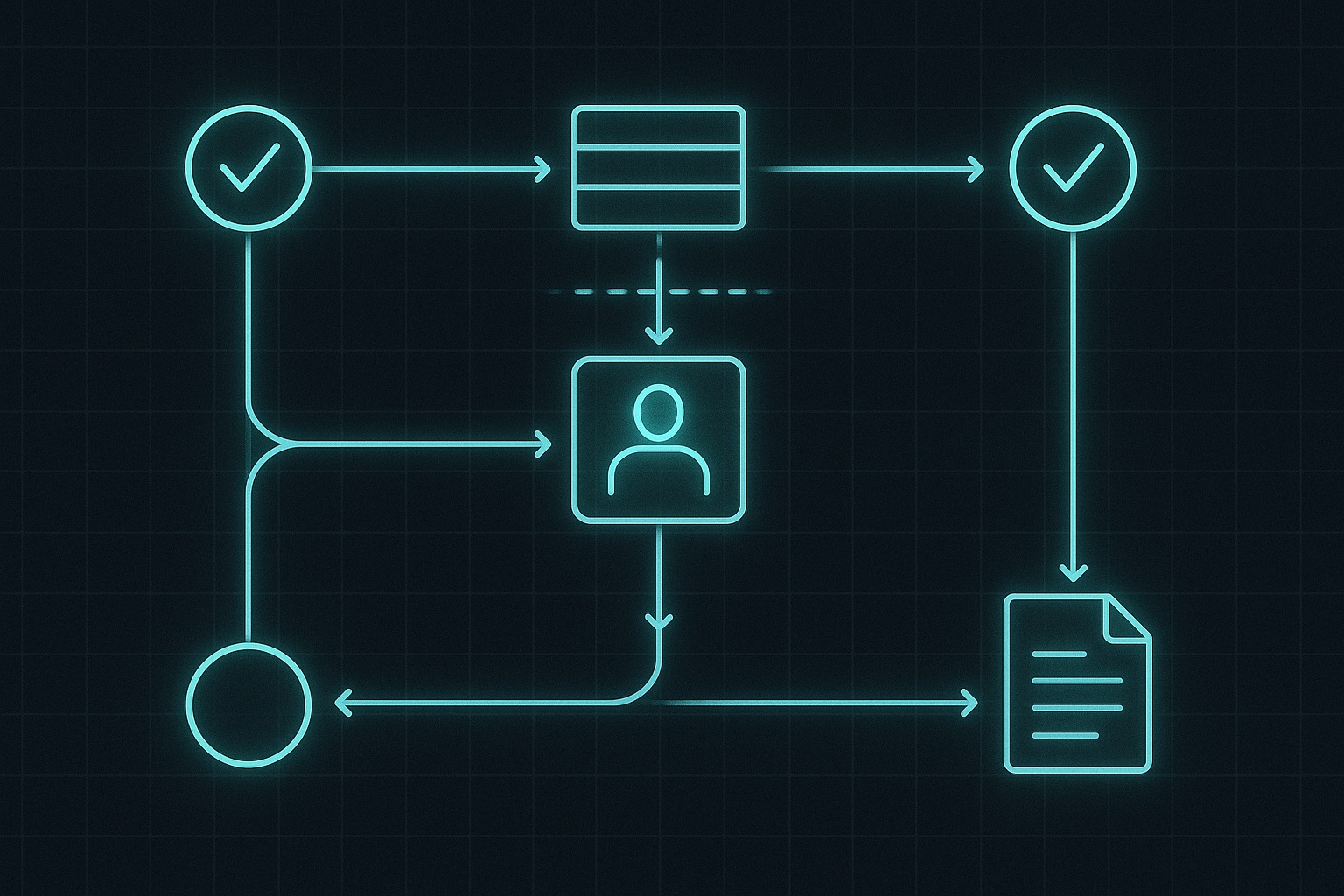
Diagram of JSON schemas and MCP tool descriptors feeding into an agent harness with approvals and traces

Tool Calling, Schemas, and the Rise of MCP

The live demo repo for this series is 67ailab/harness-engineering, and for this post I did add a real new capability before publishing. The repo now includes a small MCP-style adapter layer in src/harness_engineering/mcp.py, plus CLI entry points to inspect tool descriptors and call tools through that boundary. The exact repo change shipped in commit e21f361. That addition matters because this is the first point in the series where the demo has to answer a question the broader ecosystem now forces on every agent builder: what exactly is the boundary between your harness and the tool protocol? ...

May 2, 2026 · 67 AI Lab
Systems diagram of an AI agent connected to tools, observability, approval gates, memory, and policy guardrails

Agentic Harness Engineering White Paper

Artificial intelligence is entering a new engineering phase. For the last two years, the dominant conversation centered on prompt engineering: how to ask better questions, structure better instructions, and squeeze more reliable output from large language models. That work mattered, and still matters. But as models have become capable of planning, tool use, coding, browsing, testing, and acting over many steps, the practical bottleneck has shifted. The central production problem is no longer simply how to prompt the model. It is how to build the runtime around the model so that the model can act effectively, safely, durably, and measurably. ...

May 1, 2026 · 67 AI Lab
Blueprint-style diagram of an agent runtime surrounded by tools, state, traces, approvals, and outputs

Anatomy of an Agent Harness

The live demo repo for this series is 67ailab/harness-engineering, and this post stays anchored to the code that exists there today. I did not add a new repo capability for this article. The point of this installment is to dissect the current harness as it actually stands: what lives in src/harness_engineering/, how the pieces fit together, and which parts are carrying the reliability burden. That matters because “agent” is now a dangerously overloaded word. Many teams still mean either a model that can call functions or a prompt loop with some memory and tool wrappers. Those are ingredients, not a runtime anatomy. ...

May 1, 2026 · 67 AI Lab
Abstract diagram of an LLM connected to tools, checkpoints, approval gates, and trace logs

Why Agentic Harness Engineering Matters More Than Prompt Engineering

The live demo repo for this series is 67ailab/harness-engineering. This first post is grounded in the current public repo state rather than a made-up architecture diagram. For this article, I did not add a new repo feature before publishing; the existing baseline already supports the core claim. At the time of writing, that baseline includes typed tools, checkpointed run state, resumable execution, an approval gate before writing artifacts, per-step traces, a planner/reviewer split, and optional local OpenAI-compatible model support. ...

April 30, 2026 · 67 AI Lab
Abstract market dashboard with cloud growth, AI infrastructure, and earnings signals

Big Tech Earnings Show the New AI Trade: Monetization Wins, Spend Alone Does Not

The latest earnings reports from Microsoft, Alphabet, Amazon, and Meta delivered one very clear message: the market is no longer rewarding AI investment on faith alone. Investors still believe in the AI buildout. If anything, these results reinforced that hyperscaler spending on compute, models, networking, and power is very real. But the market has become much more selective about which AI stories it rewards. The dividing line is no longer “who is spending the most.” It is now much closer to: who can prove that AI demand is already turning into durable revenue, cloud growth, backlog, and operating leverage. ...

April 30, 2026 · 67 AI Lab
Abstract diagram of control planes, services, and cascading failure paths in a hyper-scale distributed system

A Comprehensive Guideline for Extreme Risk Identification and Prevention for Hyper-scale Distributed Systems

Hyper-scale distributed systems fail differently from ordinary software systems. Their most dangerous risks are rarely caused by one broken component. They emerge from the interaction of control planes, data planes, deployment automation, network topology, retry behavior, queueing dynamics, tenant workloads, and human operational decisions. In such systems, extreme risk means a low-frequency but high-consequence condition that can create nonlinear blast radius: regional degradation, global control-plane unavailability, cross-tenant impact, silent data corruption, large-scale isolation failure, or unrecoverable operational deadlock. ...

April 28, 2026 · 67 AI Lab
Abstract illustration of distributed systems, AI infrastructure, networking, storage, and accelerators

EuroSys 2026: Where Systems Research Is Heading

EuroSys has always been a good place to see where real systems pressure is building. The 2026 edition is especially revealing. The accepted-paper list shows a community that is no longer just building generic distributed systems abstractions. It is increasingly shaped by AI-scale workloads, accelerators, network bottlenecks, cloud efficiency, and production-grade reliability constraints. This report synthesizes the EuroSys 2026 accepted papers into a high-level map of the field: the key areas covered by the conference, the most popular areas, the major trends visible across the program, and the follow-up deep dives worth turning into a full post series. Methodology and scope This report is grounded in the EuroSys 2026 accepted papers list and the linked proceedings entry: ...

April 26, 2026 · 67 AI Lab
Layered multi-omics data streams converging into an integrated biological model

Multi-Omics Integration: The Whole Is Greater Than the Sum

Introduction: Biology Does Not Happen One Modality at a Time If genomics gives us the blueprint, transcriptomics shows what is being transcribed, proteomics shows what machinery is actually present, and metabolomics shows the biochemical consequences, then a single-omics analysis is always partial by construction. That is not a flaw in any one assay; it is a fact about biology. Cells regulate themselves through layered, noisy, nonlinear interactions. A DNA mutation may have no phenotypic consequence if the transcript is silenced. A dramatic RNA change may not matter if protein abundance is buffered. A protein-level perturbation may only become visible when a pathway rewires metabolism. ...

April 26, 2026 · 67 AI Lab
Futuristic illustration of a mid-size AI model architecture with layered neural blocks and efficient attention pathways

Qwen3.6-27B Deep Dive: Why This Mid-Size Dense Model Works So Well

Qwen3.6-27B is one of the most interesting open models released this year—not because it is the biggest, but because it makes a strong case that mid-size dense models are now good enough to challenge much larger systems when the architecture, post-training, and inference strategy are designed well. That matters. The industry has spent years obsessing over parameter count, but developers do not deploy parameter counts. They deploy systems that need to be accurate, fast, stable, affordable, and easy to serve. Qwen3.6-27B lands right in that sweet spot. ...

April 23, 2026 · 67 AI Lab
Visualization showing the evolution from large inefficient LLMs to smaller, more efficient models

The LLM Efficiency Revolution: How 8B Models Now Outperform 70B Giants

We are witnessing a massive paradigm shift in large language model development. A couple of years ago, the primary strategy to make an LLM smarter was simply to throw more parameters and raw compute at it. Today, models in the 7B to 8B parameter range easily outperform the 70B+ models of the past. This leap in “weight efficiency” isn’t happening by accident or mere trial and error. It is driven by highly deliberate, scientifically grounded methodologies across the entire training pipeline. ...

April 16, 2026 · 67 AI Lab